


Joe Barth talks to New York guitarist Miles Okazaki about performing the entire Monk songbook for the new film Monkathon.
Photo credit: Jesse Wakeman
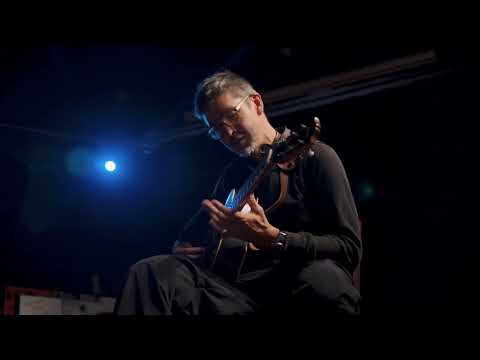
Thelonious Monk is one of the most beloved American composers in any style of music. Monk’s compositions feature dissonances and angular melodies using unexpected chromatic notes. Guitarist Miles Okazaki has taken on the challenge of performing all sixty-six of Monk’s songs as a solo guitarist. Filmmaker Frank Heath filmed Miles Okazaki performing this entire songbook in one concert as a solo guitarist.
JB: Before I ask about the Monk project, briefly tell me about yourself. You were born and raised in Port Townsend, Washington. When did you start to play jazz guitar, and in those early years, what was most helpful in your personal development as a guitarist?
MO: There were some records around the house: Dexter Gordon, Miles Davis, Monk, Wes Montgomery, classic things. I started listening to those and really digging in when I was about 12. At the same time, I had a teacher who turned me on to a lot of different kinds of music. I’ve always learned one-on-one with a teacher – that’s the best way for me.
JB: Did studying with Rodney Jones bring you to New York City? What did you appreciate most in your work with Rodney?
MO: Rodney didn’t bring me to NYC, but I discovered him when he was the guitar faculty member who gave me the worst grade on my audition at Manhattan School of Music. I said, I want to study with that guy. He’s still my teacher. He’s a consummate craftsman and knows the real purposes of music, way beyond technique, repertoire, and gigs.
JB: To you personally, what are three of the most influential jazz guitar albums that shaped your personal development as a guitarist, and why?
MO: Grant Green, Nigeria. Especially “It Ain’t Necessarily So.” The essence of heavy swing and groove, a perfect guitar tone, and patience in developing a musical statement.
Sonny Rollins, The Bridge. I’m interested in how to fit into a group. The way Jim Hall plays on here is one lesson after another.
Emily Remler, East to Wes. I studied with her briefly in 1989. This was the way that I wanted to play guitar for many years, in terms of articulation and relaxed time feel.
JB: You have immersed yourself in the music of Thelonious Monk, first by recording his entire songbook in 2018 with the six-album set Work, and now with the new film Monkathon. I’m going to ask you about some specific Monk tunes, but give us some observations “from 35,000 feet” concerning the entire Monk songbook?
MO: In my opinion, it’s the greatest body of compositions in American music in terms of a songbook that continues to be useful for generations of musicians to play and learn from.
JB: What were some special musical rewards in playing these songs as a solo guitarist?
MO: Every song taught me something new about the guitar, because they are not written for guitar.
JB: Was this project originally filmmaker Frank Heath’s idea or yours or someone else’s?
MO: It was the idea of producer David Breskin, after seeing me play a solo gig of Monk songs in San Francisco.
JB: I can only ask about a few of Monk’s songs. One of my favorites is “Well You Needn’t.” What challenges and rewards did you find in performing that song?
MO: There’s an intro to that song that nobody plays. There’s a kind of rhythmic illusion in it. The band can’t get it, and Monk says, “You can’t hear that, man? Or do you all just want to breathe oxygen?” I like to get into that frame of mind.
JB: I enjoyed your rendition of “I Mean You.” What challenges and rewards did you find in performing this song?
MO: That song has a heavy beat on 2 and 4. To do that on the guitar while playing the melody is very challenging. I had to make up a kind of technique to do that one where I choke the guitar while playing it.
JB: Again, what challenges and rewards did you find in performing “Straight No Chaser”?
MO: This song is very well known. So, I played it in the lowest octave, very fast, with an emphasis on the rhythmic instability of the phrasing. Monk only wrote blues songs in Bb, so it’s a challenge to find a different approach to each of them.
JB: Talk about the rhythmic challenges in performing “Rhythm-A-Ning?”
MO: The melody itself is not particularly challenging, but on the film, I do a thing where I play another rhythm against it, which makes it sound a little different, like there are two time signatures happening at the same time. But it’s still in 4/4, like all the tunes except “Ugly Beauty.”
JB: One of Monk’s most beloved ballads is “’ Round Midnight.” Tell us about the richness you found in that tune and why you closed your program with it.
MO: The concert ended at midnight, so it seemed like a no-brainer. I did it much differently on the original album, where I used Bud Powell’s 1950 solo as a reference along with the traditional melody.
JB: This is a difficult question, but do you have one or two Monk songs that were especially satisfying to perform?
MO: There are some that are especially difficult to get right, according to the way I decided to play them. “Epistrophy” is one, which has two interlocking parts. “Pannonica” is another, which uses a ton of natural harmonics. “Brake’s Sake” is quite satisfying, because it ends on a big G chord, unusual in the songbook. I end the first set with this song.
JB: It appears you didn’t use your 175. What guitar did you use, and what do you appreciate most about it?
MO: I used a 1940 Gibson ES150. This is basically what Charlie Christian would have played, and it put me in the mood to deal with the music from that era. It has thick strings (13s), fairly high action, and a V-shaped neck that feels much thicker than a 175. So, in that sense it’s quite difficult to play, but I enjoy the sound of it and the vibe.
JB: One final general question. New York is home to scores of good guitarists. You’ve been there most of your life. What’s the best piece of advice you’d give younger guitarists for building a career in music?
MO: Just build your skill set. There’s no rush to make your own records. Play with older musicians, not just your friends. Find a mentor. Show up early. Don’t leave a tuner hanging off the headstock. Keep the volume down. And above all – get your sight-reading together!