
Artist Features
Barcelona’s Exciting Jazz Guitarist, Josep Traver

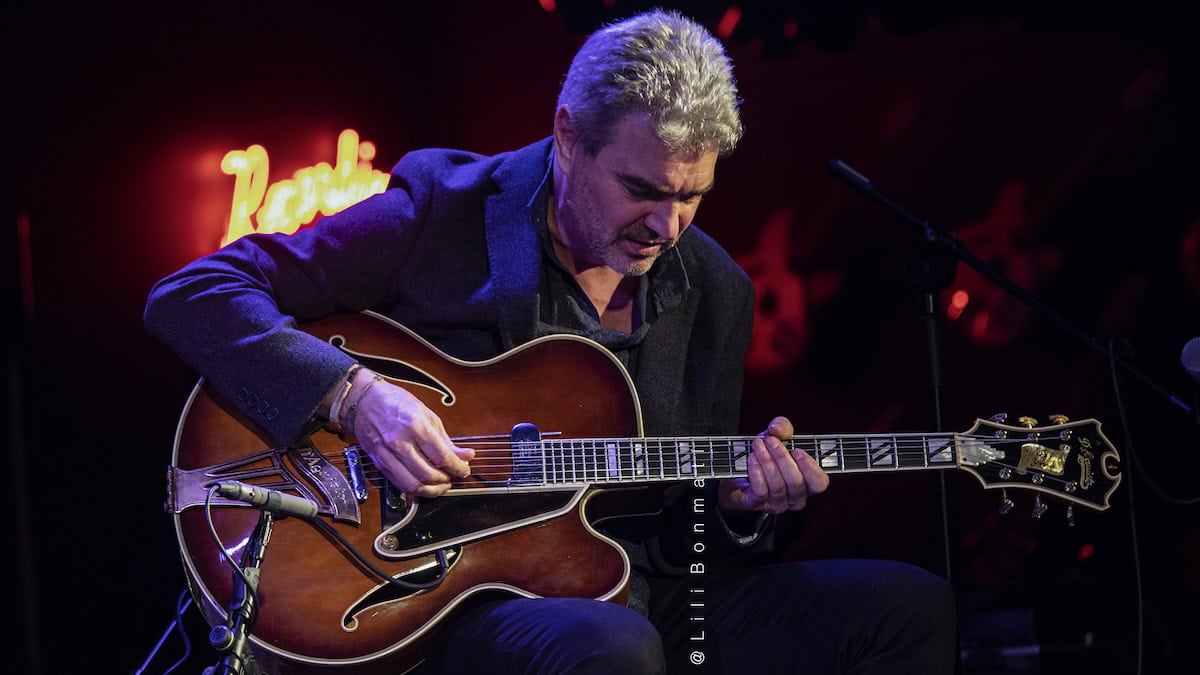
Joe Barth talks to Josep Traver, a Spanish guitarist based out of Barcelona with incredible taste and technique.
Photo credit above – Lili Bonmatí
I came across the artistry of vocalist and trumpeter Andrea Motis and was captivated by the guitarist in her group, Josep Traver.
JB: What brought about your interest in jazz guitar?
JT: The first jazz guitarist I heard play was Django Reinhardt, when I was twelve years old, I loved his virtuosity, lyricism, and his advanced harmonic concepts. Later on, I started listening to Pat Metheny, Wes Montgomery, Bill Frisell, Joe Pass, Grant Green, Jim Hall, Herb Ellis, and other classic players.

JB: During your studies at the Escola de Música Moderna de Badalona, what was helpful in your personal development as a guitarist?
JT: I learned many basic and interesting concepts from my teachers, Quique Soriano, Ramón Montoliu, Javier Juanco and Pere Soto. I learned how to read music, harmony, arrangements, chord positions, and I learned a lot about different guitar styles through studies from Berklee College of Music, and from authors like Mike Ihde, William G. Leavitt and Barry Galbraith.
JB: You have had a masterclass with John Scofield. Tell us about one or two things that were most helpful to you from the class.
JT: A student asked him about what were his thoughts after he played an intro for the song “Georgia On My Mind?” People thought he would talk about scales, arpeggios, chord substitutions, etc… However, his answer was quite simple: “I’m thinking to play beautifully.” I believe that’s what music is about, try to play the good notes.
JB: What are three of the most influential jazz guitar albums and why?
JT: Charlie Christian: Live’s Sessions at Minton’s Playhouse (1941) Charlie Christian is one of the electric guitar pioneers, later guitar masters like George Benson and Barney Kessel learned how to play listening to this genius. This album is like a jam session, you can hear Charlie Christian playing in a free environment, without the restrictions of playing for a record company. There are no arrangements, no structures, only his fluid improvisation.
Wes Montgomery: Smokin’ at the Half Note (1965). Wes Montgomery is one of the most inspiring and sophisticated jazz guitar players ever. On this live album, you can hear his astonishing rhythm, harmonic, and creative approach to the guitar. Wynton Kelly, Paul Chambers and Jimmy Cobb formed the incredible rhythm section, the same musicians who played with Miles Davis from 1959-1963.
Kenny Burrell: Midnight Blue (1963). Kenny Burrell is one of my favorite guitar players. He is a jazz guitarist with a strong blues connection. I think all of the modern music (rock, funk, jazz, folk, etc.) is rooted in the blues, and you can hear this feeling on all of Kenny Burrell’s performances. His tone is unique, I heard once that Jimi Hendrix said “Kenny Burrell, that’s the sound I’m looking for.”
JB: Talk about what you enjoy most about making music with singer/trumpeter Andrea Motis?
JT: We know each other very well, and have been playing together for about eighteen years. Andrea sings and plays trumpet and alto sax at a very high level. She is also a fine composer. She’s a great musician and it’s so easy to have fun performing at her concerts, everything is fluent and easygoing.
JB: What do you enjoy most about playing gypsy jazz with violinist Elia Bastida and bassist Joan Chamorro?
JT: I like the way Elia plays. There is no other violinist like her. She studied and transcribed the music of Stéphane Grappelli, Joe Venutti and Stuff Smith. You can hear perfect pitch, full sound, and jazz phrasing in her playing. When we perform together, I slip into this Django Reinhardt mood.
Joan is family to me, we did a lot of recordings, tours, and musical adventures together. In projects where he is the leader, I feel a deep sense of musical trust from him. It is always a pleasure to play with him, as well as Elia.
JB: You also play American-style bluegrass music?
JT: Yes indeed, I have played with The Wild Turkey Band, and we have recorded two albums. That’s because my friend, the banjo player, Lluís Gómez, loves bluegrass music and he hired me for his band. I love flatpicking, the fiddle and vocal tunes, and the way bluegrass musicians improvise. I really love guitarists such as Clarence White, Doc Watson, Norman Blake and Tony Rice, among others.
…and also rock and pop music from time to time?
Yes, I love pop music, I started playing The Beatles when I was at primary school. I also like funk, country, blues, rock and many other styles.
JB: Which of your CDs best represents your playing?
JT: I really don’t know, each album is different and reflects the music my colleagues and I have played at different moments of our careers. The personality of each band is different, and the way you play must fit in each context, and you can hear that on those CDs.
JB: Tell us about the electric and the acoustic guitar that you use most?
JT: I use mostly my D’Angelico EXL-1 New Yorker because I play jazz most of the time, but sometimes I also use my Gibson 335 for more blues or rock-oriented music. I don’t play acoustic guitar too often, but sometimes I use my Gibson LG2 from 1957, or my Guild F512 12-String.
JB: As a gigging musician, talk about the jazz scene in Spain and Europe.
JT: If your passion is music, I think you can build a life working in different professional variations. You can teach, perform, or work on different kinds of musical production. Nowadays it is difficult to live from gigging outside the country because of the travel, food, and hotel expenses. You need a big budget to tour around.
The jazz scene in Spain is full of great musicians. In Barcelona, we have three great jazz universities. But, there are not enough places to play. I think the government must promote those live music venues in order to help the owners and provide opportunities for young musicians.
Subscribe to Jazz Guitar Today – it’s FREE!
Thank you for reading this post, don't forget to subscribe!


Saying Goodbye To An Atlanta Jazz Musician, Sal Gentile

Julian Coryell Brings New Flavors of Flamenco, Gypsy, Latin and Jazz to the Tonalic Library

Australian Guitarist Zak Scerri Debuts London Trio Album

Jazz Guitar in Tasmania… and New York City

Greek Bouzouki Virtuoso and Jazz Guitarist, Michael Paouris

Jazz Guitar Today Lesson: “Central Park West”

New Album From Eleonora Strino

Jazz Guitarist Eleonora Strino Talks To JGT
Jazz Guitar Today Lesson: “Central Park West”
Jazz Guitar Today Lesson: “All or Nothing at All”

New Vince Lewis Guitar Arrangement, “Secret Love”
Jazz Guitarist Eleonora Strino Talks To JGT

First Time In The US! Eleonora Strino

More About Just Jazz Guitar Founder, Ed Benson

The Inaugural Downtown NYC JazzFest

Talking with Just Jazz Guitar Founder, Ed Benson
-
 Jazz Guitar Lessons2 weeks ago
Jazz Guitar Today Lesson: “Central Park West”
-
 Jazz Guitar Lessons3 weeks ago
New Vince Lewis Guitar Arrangement, “Secret Love”
-
 Artist News2 weeks ago
Jazz Guitarist Eleonora Strino Talks To JGT
-
 Artist News4 days ago
Saying Goodbye To An Atlanta Jazz Musician, Sal Gentile