
Artist Features
JGT Interview With Sydney’s Carl Dewhurst

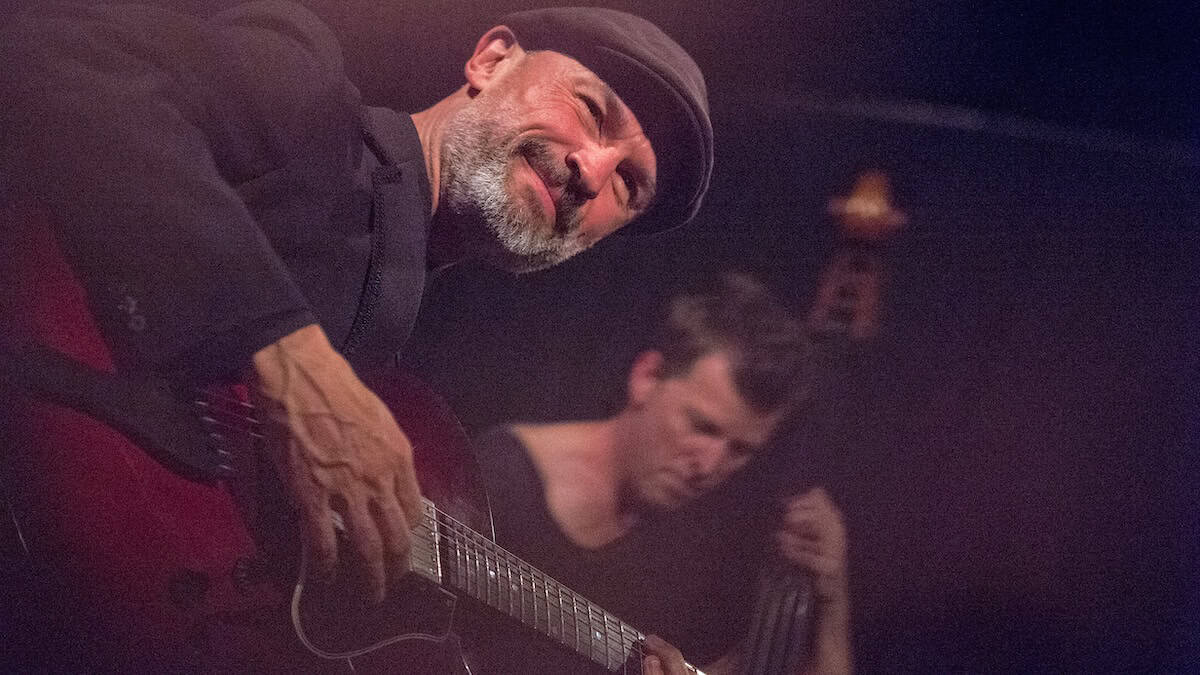
Jazz Guitar Today contributor Joe Barth talks with Sydney, Australia’s first-call guitarist, Carl Dewhurst.
Equally active as a guitarist and composer, Carl Dewhurst, is also an Associate Lecturer at the Sydney Conservatorium of Music. During his musical career, Carl has worked in New York City, London, and Amsterdam and is currently a first-call guitarist in Sydney, Australia.
JB: Growing up in Canberra, what led you toward playing jazz?
CD: I started learning guitar when I was nine. When I got my first electric guitar at 12, my sister’s boyfriends—who were both really into guitar music—got me hooked on Jimi Hendrix, Stevie Ray Vaughan, Carlos Santana, and George Benson. So, by my mid-teens, with jazz in the mix, I started getting more interested. I began learning some standards, bop heads, and solo guitar stuff. Joe Pass’s solo guitar style got me hooked. Around that time, I also discovered Wes Montgomery and Kenny Burrell. My mum was super happy I was getting into jazz—she grew up listening and dancing to it, so she knew all the tunes. When I learned my first standard, “Don’t Get Around Much Anymore,” she knew every word and sang along, which encouraged me to keep going.
JB: To you, what are three of the most influential jazz guitar albums and why?
CD: The first album that got me excited about jazz guitar was Virtuoso by Joe Pass. I was a teenager when I first heard it, and Joe’s playing blew my mind. Even now, I feel like I’m seeing stars when I listen to his playing on that record. It was the first jazz guitar playing I transcribed, and it inspired in me a deep love for the solo style.
Another highly influential album for me early on was Midnight Blue by Kenny Burrell. When I first heard Kenny on that record, I was knocked out by his sound. I remember putting it on the stereo and just losing it. I was like, how do you get that sound? His tone is sparkling, bright, and clear, yet warm and lush. For me at the time, his was the perfect archtop sound, one I tried to emulate for many years.
While not an album led by a guitarist, The Bridge by Sonny Rollins, featuring Jim Hall, is one of my all-time favorites. I just love the way Jim plays on that record: his “strummy” comping, minimal, thematic soloing, and his use of space. He plays like a guitarist, not a guitarist trying to be a piano player. He’s such a perfect contrast, yet complement, to Sonny, and it gave me a strong sense of how I’d like to play the guitar in a quartet setting.

JB: In 1993, you moved to London and taught at Thames Valley University. What did you appreciate most about that era of your life?
CD: I was in London for three years, and it was a transformative time. I had arrived after a six-month stay in NYC, so I was itching to practice. I put a lot of hours in on the guitar, working on my chops, reading, and rhythm in particular. I became good friends with the late guitarist Dave Cliff, who was a wonderful mentor. He passed a lot of work onto me, and I even subbed for him with Mose Allison once. We jammed a lot, and I’d go hear him play regularly, sometimes with touring American artists like Lee Konitz. I also became good friends with fellow Australian guitarist Carl Orr, and he too helped me enormously. He got me my teaching gig and introduced me to Ike Issac’s close friend, guitarist Cedric West.
Cedric had led a guitar quartet in the 60s and would have regular jams at his house. Carl and I would visit every week, devour Cedric’s delicious curry, and play guitar quartet arrangements, including handwritten charts by a very young Kenny Wheeler. When Ike Issacs passed away, Cedric’s quartet was invited by Martin Taylor to play at his memorial at Ronnie Scott’s. To my astonishment, John Williams and Paco Pena were in the audience and played after us. I couldn’t stop smiling. It was the best. I also formed a group with the brilliant late saxophonist Stephen Main and drummer Gary Willcox called Burnt Orange, playing original tunes, and we played a lot.
JB: What brought about your move back to Sydney in 1997? How did you find the jazz scene there in terms of making a living as a player?
CD: While the music scene in London was incredible, and I was able to experience many great things, I was often out of work and homesick. My friends in Sydney would call me with stories about how many gigs they were doing, so after a few years of struggle, I decided to move back. Ironically, it took me some time to adjust to being home. Sydney felt like a small town! However, there were lots of gig opportunities, and after a period of settling in, I was working a lot. This included not only jazz gigs but also commercial work.
I won the Ike Issacs International Jazz Guitar Competition in 1998, and with that came not only a new Gibson 135 but also a recording deal with ABC Radio, which led to my first album as a leader. After a couple of years, I joined vocalist Vince Jones’ band, and soon after, the James Morrison Quintet, with whom I played for many years. I also joined the Australian Art Orchestra in 2000, with whom I toured extensively until around 2015.
JB: Tell us about what you mean when you perform “genre-defying” and “free jazz” like you do with your quartet NUDE.
CD: NUDE was an interesting band in that we played music inspired by some fairly disparate sources. You could say NUDE was an Ornette Coleman, Harmolodic-inspired funk/punk band that also drew inspiration from electronic dance music and the polyrhythmic/odd meter rhythms of Steve Coleman. Essentially, we were a high-energy, groove-driven, free-improvising quartet.
I use the term “genre-defying” more as a reference to the context of that band in Sydney in the 1990s. At that time, most of the live music venues in Sydney—and indeed other Australian capital cities—were pubs. Historically, all of the iconic rock and pop music that has come out of Australia has been crafted and honed in the “pub rock” scene. This was also true for jazz. Somehow, NUDE, due to its eclectic influences, would end up playing all manner of pub gigs to both jazz and non-jazz audiences. Our music, whilst being avant-garde jazz, managed to work in a variety of venues and appealed to many non-jazz listeners.
JB: What do you appreciate most about performing with the Korean/Australian group Daorum?
CD: Daorum is a group formed in 2005 by my good friend and colleague, drummer Simon Barker. Simon spent many years studying traditional Korean drumming and eventually brought trumpeter Phil Slater, pianist Matt McMahon, and me to Seoul to perform with two of his mentors, drummer Kim Dong Won and vocalist Bae Il Dong. It was a big risk for Simon, but his vision for the meeting of music from two cultures worked brilliantly. Il Dong and Dong Won are master musicians who are wonderful improvisers, so everything between us clicked beautifully. Since 2005, we’ve performed all over the world, including at the Lincoln Centre in NYC. For me, the special thing about Daorum is that each person is able to fully be themselves and perform without compromise, regardless of their musical backgrounds.
JB: Tell us about one of the soundtracks that you composed.
CD: In 2008, I was invited by director Neil Armfield to compose and perform live the soundtrack to the Belvoir St Theatre production of Scorched. For this production, I wrote much of the music while rehearsals took place. I’d watch the action and come up with ideas for the underscore, and sometimes play as well. Much of what I did on the guitar involved extended techniques, alternate tunings, and electronics. I used slides, mallets, a bow, and other devices to create all manner of textural soundscapes, techniques I’d developed in the duo Showa 44 with drummer Simon Barker. I was also responsible for many sound effects like machine gun fire, explosions, and the revving of engines. The big challenge was that everything I devised had to be played live. I used three guitars, lots of pedals, and several amps. It was grueling, but I felt like a kid in a candy store.
JB: What do you appreciate most about the main guitar that you use?
CD: At present, I’m going through a transitional phase with my guitars. For years, my main jazz guitar has been a Gibson L5 Studio, which I bought in 2002. I’ve also played a Yamaha SA1200s, which is essentially an L5 type instrument. Now, as I’m getting older, I’m finding the large-scale archtops harder to manage physically. Last year I picked up two archtops: a Gibson ES175 and an Eastman AR503CE. Both these instruments are wonderful, and much smaller and lighter. The 175 is a classic, and I love it. The Eastman is a beautiful guitar and stunning considering the price. I love the weight and dimensions of the Eastman. It has a wider string spacing than the Gibsons, which my hands really appreciate, and the narrow body is very nice ergonomically. The Eastman also has a carved top and wooden bridge, which tonally reminds me a lot of the L5. So yeah, at the moment, I’m switching between these two instruments, and I don’t have a favorite at this stage.
JB: Tell us about your most recent album.
CD: My trio, with Cameron Undy on bass and Alex Inman Hislop on drums, has been playing regularly in and around Sydney since 2022. In July, we recorded an album entitled Avicennia, which also features my old friend, NY-based alto saxophonist Lisa Parrott. The album is due to be released in 2025. The tunes on Avicennia are an evolution of musical ideas initially developed on my previous albums Old Man Rock and Drainpipe Blue. The defining characteristic of these albums is a focus on specific polyrhythmic concepts based on quintuplet and septuplet-based language. This work forms the foundation of my research as an academic at Sydney Conservatorium of Music.
Subscribe to Jazz Guitar Today – it’s FREE!
Thank you for reading this post, don't forget to subscribe!


“Along The Low Road” Featuring Guitarist Gustaf Ljunggren

New Vince Lewis Guitar Arrangement, “Anything Goes”

Guitarist Paul Ricci Releases “The Path”

Australian–Canadian Quartet Open Thread Return with Waiting Music

British Smooth-Jazz Guitar Master, Chris Standring

Jazz Guitar Today Lesson: “Pensative”

Saying Goodbye To An Atlanta Jazz Musician, Sal Gentile

Julian Coryell Brings New Flavors of Flamenco, Gypsy, Latin and Jazz to the Tonalic Library
Jazz Guitar Today Lesson: “Pensative”
Jazz Guitar Today Lesson: “Central Park West”
Jazz Guitar Today Lesson: “All or Nothing at All”
New Vince Lewis Guitar Arrangement, “Anything Goes”
New Vince Lewis Guitar Arrangement, “Secret Love”

Jazz Guitarist Eleonora Strino Talks To JGT

More About Just Jazz Guitar Founder, Ed Benson

The Inaugural Downtown NYC JazzFest
-
 Jazz Guitar Lessons1 week ago
Jazz Guitar Today Lesson: “Pensative”
-
Jazz Guitar Lessons3 weeks ago
Jazz Guitar Today Lesson: “Central Park West”
-
 Jazz Guitar Lessons43 minutes ago
New Vince Lewis Guitar Arrangement, “Anything Goes”
-
Jazz Guitar Lessons4 weeks ago
New Vince Lewis Guitar Arrangement, “Secret Love”