
Artist Features
Matt Panayides Releases a New Album “With Eyes Closed”

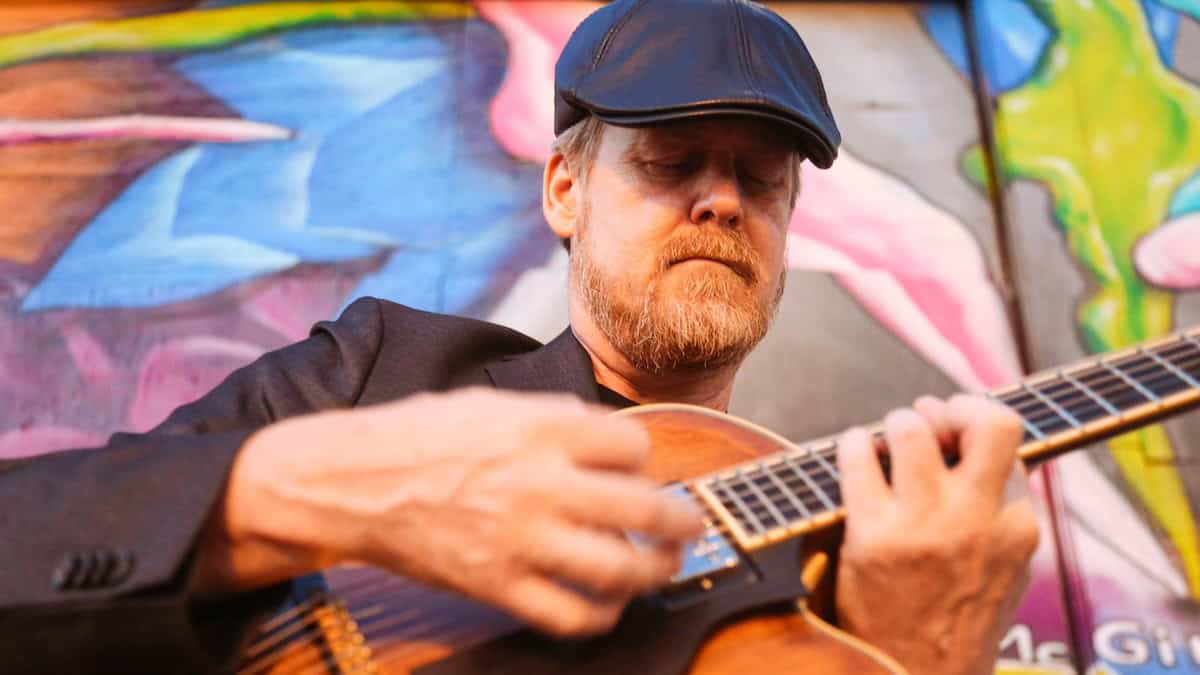
JGT contributor Joe Barth talks to guitarist Matt Panayides about his latest release, “With Eyes Closed”.
Born in Ohio and raised in Indiana, Matt Panayides, as a late teenager chose the Manhattan School of Music as a college and has stayed in New York City ever since. Influenced by a number of the greats from Wes Montgomery to Jimi Hendrix he has carved out a career performing around the Metro area and abroad. Matt has just released a new album, With Eyes Closed, with his trio.
JB: You haven’t been featured in JAZZ GUITAR TODAY. So, before I ask about the new album, tell me about yourself. I believe you were born in Ohio and started on the piano. Then you heard Jimi Hendrix and Led Zeppelin. When did you start to play jazz guitar and what was most helpful in your early personal development as a guitarist?
MP: I was born in Cincinnati but raised in the small town of Springfield, OH. My mom played piano so my older sister and younger brother and I all took piano growing up. Around age ten I moved to Indianapolis, and around this time heard Led Zeppelin for the first time in my cousin’s basement. I really loved the sound of the guitar and started playing it. My middle school band director later realized I played guitar and asked me if I wanted to join the jazz band, and I was all for it, though I knew almost nothing about what that would entail. This director was quite honest about not knowing what the guitarist should play, so he encouraged me to go to an Aebersold camp in Louisville sometime around 8th grade. And it was there that I was exposed to a whole other world of music. I spent a summer before my senior year in high school at Interlochen Arts Camp in Michigan. Going into the woods and taking classes only about music really inspired me. I practiced a lot that summer, and after that the die was cast.

JB: In addition to Jim Hall, Sco, Wes, and the other jazz guitarists who have influenced you, you mention Joni Mitchell. Talk about this.
MP: Joni Michell pulled me in with her voice the first time I heard her, though I wasn’t sure why. Something in her lyrics, tone, and wisdom drew me in. Besides working on jazz, I was also beginning to write a lot of music at this time. I think Joni’s song writing influenced the way I would put words and music together. There’s a sense where the music is serving the lyric bringing out hidden meanings between the words that appealed to me. There was not a specific form that the words were trying to take, it all revolved around the expression of an idea without concern for any specific rules. The open chord sounds that she achieved through different tunings and unusual strumming techniques created a sound that I still value and use. Crunchy voicings are great with minor seconds in the middle, but I also love those big stacked 4ths and 5ths kind of chords as well. She also got me thinking about how a composition created its own universe in itself and didn’t need to obey any other outside rules to be effective. The rules could be written in the song, and then developed, no matter if outside that setting the music was “breaking” the rules.
JB: Talk about Rodney Jones and pianist Garry Dial and their special impact upon you as a musician.
MP: Rodney Jones is a major influence in my musical life. He became my first real mentor on the guitar, and his guidance in all things musical and spiritual have had a lasting impact. His synthesis of Grant Green and George Benson while always striving for something new have been values that I have held dear. I learned how to swing and groove by playing with Rodney in our lessons. The idea of something being “caught” and not “taught” really resonated with me. He would play things and I’d record the lessons, he’d have me go home and transcribe what he played and work it out. Some of my favorite lines on the guitar are direct references to Rodney.
I met Garry Dial soon after moving to NYC for school and I was fortunate to have some harmony and improvisation classes with him. He demystified and laid a foundation in jazz harmony and the theoretical underpinnings of jazz improvisation for me. His unwavering work ethic and belief in the power of music personally carried me through some tough times as I struggled to build a life in music. Later, I sought him out as a private teacher, and through these lessons he revealed many of the teachings of Charlie Bannacos, an important teacher to so many musicians. He also led me to a more pianistic approach to guitar voicings, leading me away from some of the more common jazz guitar chord “boxes”.
JB: What are three of the most influential jazz guitar albums to you and why?
MP: This is extremely tough. I will have to leave out several important ones, most notably albums by Jimmy Raney, John Abercrombie, Jim Hall and Pat Metheny! But that must wait for another time.
Wes Montgomery: Incredible Jazz Guitar album has it all. It contains all the essential elements of jazz guitar playing. Super swinging, great linear clarity, storytelling, and the great jazz sound so often imitated but only ever accomplished by Wes! Although the recording quality on this particular album is not the best, the elements of his playing are in full effect. I spent many years trying to achieve this sound, no pedals, hollow body guitar straight into a Polytone amp 🙂 No one likes this setup these days but when I was learning it was THE jazz guitar sound. The clarity of Wes’s melodic lines is breathtaking. His combination of blues phrases and bebop lines is played with a great swing feel and sound. Also, it contains great demonstrations of the way that Wes would build a solo’s intensity by first playing single lines, then moving on to octaves, and building to a climax with lush chord solos played effortlessly.
Grant Green: Green Street-Grant’s sound, single note playing, and rhythmic feel have left a lasting impression on me, and this was the first album I heard of his that drew me into his world. He plays seemingly simple lines, but in their application no one can do it like him. This is a trio album where Grant plays almost like a horn player, without any chordal accompaniment, just beautifully simple single lines and bluesy phrases which really are very moving to me. On later records, I would always hear his guitar lines playing a long with some of the most powerful saxophonists of the time (like Joe Henderson) and the guitar creates a great texture with these other instruments.
John Scofield: Time on My Hands– Scofield is my absolute guitar hero. He has this amazing harmonic sophistication but he presents it in a laid-back way with lots of space. His solo guitar moments on this album were an obsession of mine for a long time, his way of implying the time, hinting at it just enough to make it really obvious and swinging. For me, this is the first album that led me into more of a “modern” jazz guitar sound. His subtle use of effects made his guitar sound new and in the moment, not looking backward but moving forward standing on the shoulders of giants. The instrumentation of this album became a template for how I would approach composition and my first several bands: guitar, tenor, upright bass, and drums. There’s a lot to learn from how he arranges his compositions. Scofield’s tunes are well-structured, combining modern jazz sounds with memorable, singable melodies.
JB: The new album With Eyes Closed was recorded with your creative reworking of some classic Standards. Reflect upon the material selection for the recording.
MP: This is the first album of mine in which I recorded compositions by other composers. All of my other recordings are based around my original compositions. While I have always worked on jazz standards, studying, practicing, and playing them, I never felt that I had an authentic way to present this material. It’s one thing to play a standard for a cocktail hour, but quite another to elevate it to a work of art. But in the past couple of years, I’ve reached a point where I feel I’ve found an authentic way to approach these compositions. By approaching them through the lens of my own compositions and improvisations I felt I had something unique to contribute and to express. So, for this album, I decided to highlight the compositions and composers that had such an important influence on my life and my music and to hopefully honor their legacy in the process. Two of my favorite saxophonists are Wayne Shorter and Joe Henderson. Besides studying their music, their improvisational approaches have influenced the way I play and led to the lifelong goal of trying to apply saxophone language to the guitar. Cedar Walton and Chick Corea are two pianists who have had an important influence on the way I compose and approach jazz harmony. Compositions by both seemed natural to include. Simone is such a fun tune to play, it had to be included and it’s certainly important to highlight the legacy of Frank Foster. The “Moontrane” by Woody Shaw is directly related to the Shorter and Henderson tunes. And with the two older and most common standards, “I Fall In Love Too Easily” and “Moon River”, I intended to honor them by playing them in a completely new way, preserving the melody but reharmonizing them in ways similar to my own compositional approach, using open spacious chords, parallel harmony, and changing grooves. And the common standard “Darn that Dream” I love to play, but wanted to make it more of a singular statement by starting the tune as you might expect it to be played, but then it falls off a cliff into the deep end.
JB: Bassist Steve LaSpina and drummer Anthony Pinciotti are a wonderful rhythm section. What do you appreciate about them as musicians?
MP: Their ears and their openness. They create a freedom where I feel anything I do they will catch, respond to, validate, and elevate. I like to push and pull the rhythm, sometimes in front of the beat, sometimes behind. It takes a mature rhythm section to know when not to follow me, to honor the music, and to trust that there’s intention behind what I’m trying to do. As soloists, Anthony is one of the most melodic drummers I’ve had the pleasure to play with. I could sing his solos, and I hear the melody clearly but subtly all the time. Steve is such a bass virtuoso that he lays a solid foundation for all our explorations. His bass lines have a remarkable, melodic quality that I love to listen to, and his soloistic voice is incredibly sophisticated, always swinging. It’s such an honor to record with a jazz master like Steve LaSpina.
JB: Talk about what you appreciate about the Victor Baker guitar that you recorded this album with.
MP: The Victor Baker guitar I used on this album has been essential to my recent work. It has a clear, warm sound, and the playability is consistent across the entire neck, unlike other guitars where some areas are better than others. It also stays in tune well. One of the key lessons I learned from Mulgrew Miller was to strive for clarity in sound, melody, and harmony. This guitar helps me achieve that more easily.
JB: You live in New York where there are numerous guitarists. Talk about the gigs you do and how you make a career in music work for you.
MP: To make it work for me in NYC, I’ve needed to juggle as many different opportunities as I can. I have always valued being a bandleader and making regular gigs that feature my music and the musicians I most want to play with. But being a bandleader usually also means less money, more work and less time. So, over the years I have also played many different kinds of gigs to keep the lights on: corporate functions, weddings, happy hours, cruise ship tours, bar gigs, singer-songwriter gigs, rock gigs, and basically anything else that paid and kept me playing. But also, importantly for me, there has always been an educational component to what I do. From my early days in high school as a guitar player until now I have always had some students. I enjoy teaching and appreciate the challenge of explaining concepts that are often better conveyed nonverbally. Also, I truly believe music is a powerful force in this universe that helps us better understand the reality we live in and how to relate to other beings on this planet. I feel very fortunate to have been led to this understanding, and I believe it is an important message to share with others. Teaching can help provide a stable income, which would eventually allow me to be more selective about the gigs I play. And now I’ve created my own school where I can teach and also hire other musicians providing them with the opportunity to do what I have done. This allows me to get away more easily for out-of-town gigs and small tours that I want to do.
Subscribe to Jazz Guitar Today – it’s FREE!
Thank you for reading this post, don't forget to subscribe!


Vocalist Elina Duni and Guitarist Rob Luft Continue Their Musical Journey

“Along The Low Road” Featuring Guitarist Gustaf Ljunggren

New Vince Lewis Guitar Arrangement, “Anything Goes”

Guitarist Paul Ricci Releases “The Path”

Australian–Canadian Quartet Open Thread Return with Waiting Music

British Smooth-Jazz Guitar Master, Chris Standring

Jazz Guitar Today Lesson: “Pensative”

Saying Goodbye To An Atlanta Jazz Musician, Sal Gentile
Jazz Guitar Today Lesson: “Pensative”
Jazz Guitar Today Lesson: “Central Park West”
New Vince Lewis Guitar Arrangement, “Anything Goes”
New Vince Lewis Guitar Arrangement, “Secret Love”

Jazz Guitarist Eleonora Strino Talks To JGT

More About Just Jazz Guitar Founder, Ed Benson

The Inaugural Downtown NYC JazzFest


