
Artist Features
Brian Nova, In-demand Studio Guitarist in the Pacific Northwest.

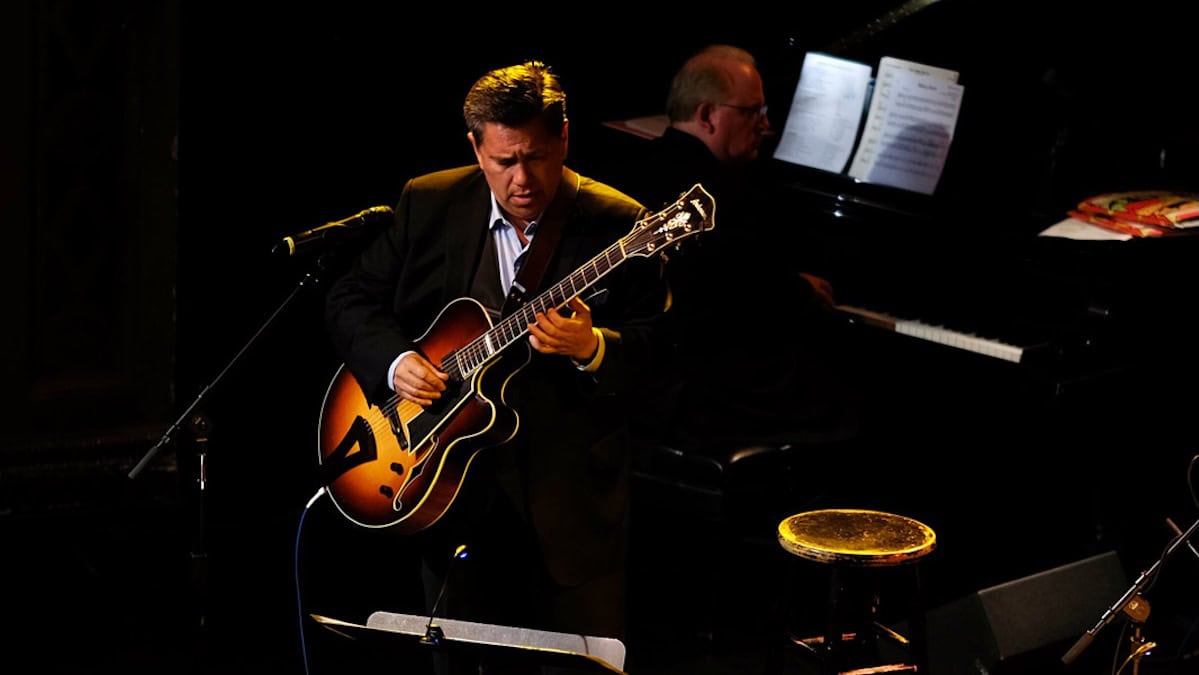
Joe Barth talks to guitarist Brian Nova from the Emerald City’s busy expanding jazz scene.
Brian Nova has toured Europe regularly as well as performing in Asia. Before he died in 1994, he and the great Joe Pass toured through Europe, the West Coast of the United States as well as across Canada.
Brian has also performed with Red Mitchell, Herb Ellis, Niels-Henning-Orsted-Pederson, Bobby Watson, Frank Foster, Bud Shank, Stanley Turrentine, Leroy Vinneger, Mel Brown, Pete Christlieb, Mundell Lowe and many more. Along with his busy concert schedule, he also conducts clinics, teaches privately, and is one of the most in-demand studio guitarist in the Pacific Northwest.
JB: What inspired you to play jazz guitar?
BN: I was playing guitar from an early age, but was into Funk, Soul, Country Rock, and Classic Rock… as was most kids in the 70’s. I had a girlfriend whose mother invited me to go hear a ‘Jazz Guitarist’. I was reluctant at first because I had the uneducated notion that a Jazz Guitarist would sit and play songs like “Misty” all night long. Well, the guitarist she took me to was Herb Ellis. When he first got on stage, he shuffled around and fiddled with his pants and shirt cuffs, trying to get comfortable. All the more reason I believed he would probably have a stroke before the bridge. When he started to play, it was I who thought I was going to have a stroke. I had no idea the guitar could be played like that. I was completely blown away. I’ve been hooked ever since. Herb took me under his wing and was the first to teach me what Jazz Guitar was really about.
JB: Talk about the things you appreciated most about your undergraduate guitar studies at Seattle University.
BN: At Seattle University, I was VERY fortunate to have one of the most amazing professors of music in my life, Louis Christianson. Louis was an immensely gifted and one of the most knowledgeable men I had ever encountered. He was the one who really opened my eyes to not just composition, arranging, and the usual musical studies but also to Jazz’s influence in Europe. Louis was from Copenhagen and was well aware of Jazz’s prominence in Europe and why so many Jazz artists fled there. I also had to play Upright Bass and Drums in our band at SU. Both were important to my sense of time and having the viewpoint from all around the bandstand. That, in and of itself, was and still is very beneficial.
JB: To you, what are three of the most influential jazz guitar albums in your development as a guitarist, and why?
BN: The first most influential album was Hello Herbie, which was an Oscar Peterson recording done in the Black Forest in Germany. It was Herbie’s favorite album, he had told me many times, and it was the re-uniting of Oscar and Herbie. Herb sounds wonderful and is helped by having a drummer. So it never sounds like a third of the band left the room whenever he solos. It might be my favorite Oscar record as well. Oscar told me it was one of his favorites. It showcases Herb’s ability to move from soloist to backing up Oscar with unbelievable ideas and energy. A master class.
The second would be the Virtuoso series recordings. I remember Herb Ellis playing this album for me, and I asked him, ‘Who are they?’ And Herbie responded, ’THEY… are Joe Pass.’ I could not believe my ears. All I knew was, ‘I want to learn how to play that!’ Herb introduced me to Joe, and I spent many years learning his style in front of him as well as alongside him. It was the album that re-wrote what solo guitar was going to sound like moving forward.
The third would be George Benson’s Breezin’ album. You could NOT be a guitarist in the ‘70s and not know GB. He was so dominant. I know many think of GB as the godfather of smooth jazz, but I heard a level of depth to his playing, a level of mastery that could ONLY come out of the straight-ahead Jazz idiom. It led me to learn more about George’s past and eventually led me to one of my biggest heroes – Wes Montgomery. It was a transitional album for me. First, it was the best mixed/mastered/arranged Jazz Guitar album to that date. It STILL sounds amazing today. Secondly, Herb would always say, “Play what you sing, and Sing what you play.” GB’s version of ’This Masquerade’ was a master class in that ideology. It allowed guitarists to see and hear this in real time. Third, I wanted to know where GB came from, where all this musicality and melody came from, and who his influences were. And that led me down the path to Wes. Which changed everything.
JB: You had a special relationship with two icons of jazz guitar. Tell us about your relationship with Joe Pass.
BN: As I mentioned earlier, I met Joe through Herb Ellis. Joe was in part, my ‘musical father.’ And he, in turn, used to call me his son. It was something I carried with great honor and reverence. Joe and I traveled quite a bit. I would get the call when he would perform Solo without his Quartet. We never spent a lot of time rehearsing or practicing. Joe felt that Jazz should be conversational, improvised, and of the moment. My understudy occurred each night sitting next to him… playing… learning. I was lucky that I knew a LOT of songs. It was what really caught Joe’s eyes and ears about me. It wasn’t how fast I played or that I could comp like Herb or Freddie Green, it was that I knew tunes. We played a game where we would quiz each other on tunes. I had played for years with a virtuoso pianist, Primo Kim, who knew thousands of songs and played them in many keys for singers who wanted to join in. It was there that I realized the true language was spoken through the American songbook and the Jazz Standards. I learned those songs and learned how to play them in all 12 keys and in at least three-time signatures. I learned how to play those songs in different rhythms and styles. Joe’s approach was that most musicians know/learn one version of a song, in one key, in 4/4. You need to be able to play that song in any key and multiple rhythm signatures. I was with Joe when he passed. It was so hard and chaotic. Very much like Joe’s life. Our pal, John Pisano, asked if I would play at the funeral. I remember getting ready to play, and right in front of me in the first pew was Joe’s Mom. I thought to myself, you need to channel Joe, you need to get thru this. You can’t mess this one up. After the service, his Mom came up to me, grabbed me, gave me a huge hug and a kiss, and whispered to me, ‘You sounded just like my Joey.’ I get teary to this day thinking about that moment… and Joe.
JB: Tell us about your relationship with Herb Ellis.
BN: If Joe was my musical father, Herb was my musical grandfather. Our relationships were very much in that realm. Joe was a bit demanding, serious, like a Dad, and taught me in a fatherly, Italian/Sicilian way. Herb was kind, gentle, and patient. Herb spent several Thanksgivings with my family here in Seattle. We traveled a lot together, and he introduced me to so many greats like Ray Brown, Oscar, Sweets Edison, Clark Terry, Barney Kessel, Charlie Byrd, and many others who all became great friends. Herb had the most impeccable time. He taught me time… how to swing. It was unbelievable being next to him night after night. No matter what I threw at him, it all sounded corny next to his concept of time. He was a juggernaut. Herb was the one who really cemented my desire to become a full-time Jazz musician. I remember one night, we were in Oregon somewhere, and I asked Herb ‘Do you ever get tired of this out here on the road?’ And I remember him telling me, ‘Brian, you need to treat Jazz like a cause, like a belief. You hold up that flag in the air, you wave it, and let folks know that Jazz is not dead. It is very much alive.’ Those were words I took to heart and carry with me to this day.
JB: You are both a guitarist and a singer. Tell us briefly how you use your voice and guitar to connect with an audience and pace your performance.
BN: It was Joe Pass and Eddie Harris who both told me I should sing more. I’ve been working on it for a long time. One of the keys is ‘Call and Response’. I learned it from studying the master of it – Nat ‘King’ Cole. This is essential, especially for guitarists. We don’t have ten notes and a sustain pedal like a pianist does, so much of what I do is more of an illusion, implying movement rather than actually trying to play everything. Let the listener ‘fill in the blanks’.
What vocals do, is help you tell the story. It is also vital in learning songs. You won’t be so apt to mess up a melody or chord form if you know the words. Being able to sing helps pace your set with songs concerning subjects you might want to talk about but would not be as meaningful without the words. People REALLY connect with the words of the song. It has made an enormous difference for me to be able to play and sing. It can help you connect with your audience on a level that most musicians can’t with instrumentals.
JB: Tell us about your CD The Upside of Lonely.
BN: My CD The Upside of Lonely is a collaboration with a bunch of friends of mine. It was supposed to have a big bang for its release, but it ended up being released on the same day as the COVID lockdown, March 2020. It features songs written by some friends of mine, as well as some standards. The musicians are wonderful: Tom Scott, Shelly Berg, Laurence Hobgood, Terry Miller, Larry Dunlap, Dillon O’Brian, and Andy Fraga Jr. It was produced by one of my dear friends, Dan Levitan.
JB: What do you appreciate most about the Benedetto guitar you use?
BN: I love my Benedetto. I play that exclusively. Howard Paul and the folks at Benedetto really made an amazing instrument when they asked me about what I would like in a Benedetto. It is just profound that this instrument will do all I ask it to. It is light and very acoustic sounding. I am just finishing up a High-Rez recording for Octave Records. They record at these insane bit rates, and the Benedetto sounds incredible! I can’t wait for folks to hear it. We are just finalizing the last mixes, and it should be released very soon.
JB: Talk about the jazz scene in Seattle and the gigs that you do.
BN: I have moved back to Seattle, and I just love being here. I have a residency at The Four Seasons Hotel in Seattle. It has been just wonderful, as it allows me to stay home more. It’s a beautiful hotel with a gorgeous view of the Seattle waterfront, right next to the Pike Place Market. I have been so tired of traveling for the past 35 years, and it is harder to travel these days. Try lugging a 38-pound guitar case through Denver, Dallas, or Amsterdam airports. I’m so happy to be able to stay close to home, keep my chops and voice up, and learn new tunes. I still travel a fair amount, but not like before. I can take the gigs I want to play or that pay for me to leave home. I think Seattle is bouncing back. There are all kinds of great musicians here, and the gigs are starting to open up. It reminds me of the late 80’s in Seattle when I was just making my start here.
Thank you for reading this post, don't forget to subscribe!


Guitarist Russ Spiegel Releases New Album: TimePieces

A Rare One-Time Coming Together of Guitarist Mick Goodrick and Pianist Fred Hersch

Jack West, Bay Area Explorer of New Guitar Sounds

Vocalist Elina Duni and Guitarist Rob Luft Continue Their Musical Journey

“Along The Low Road” Featuring Guitarist Gustaf Ljunggren

New Vince Lewis Guitar Arrangement, “Anything Goes”

Guitarist Paul Ricci Releases “The Path”

Australian–Canadian Quartet Open Thread Return with Waiting Music

Jazz Guitar Today Lesson: “Pensative”
Jazz Guitar Today Lesson: “Central Park West”
New Vince Lewis Guitar Arrangement, “Anything Goes”
New Vince Lewis Guitar Arrangement, “Secret Love”

Jazz Guitarist Eleonora Strino Talks To JGT

More About Just Jazz Guitar Founder, Ed Benson

The Inaugural Downtown NYC JazzFest


