
Artist Features
Keeping Jazz Active on the Canary Islands

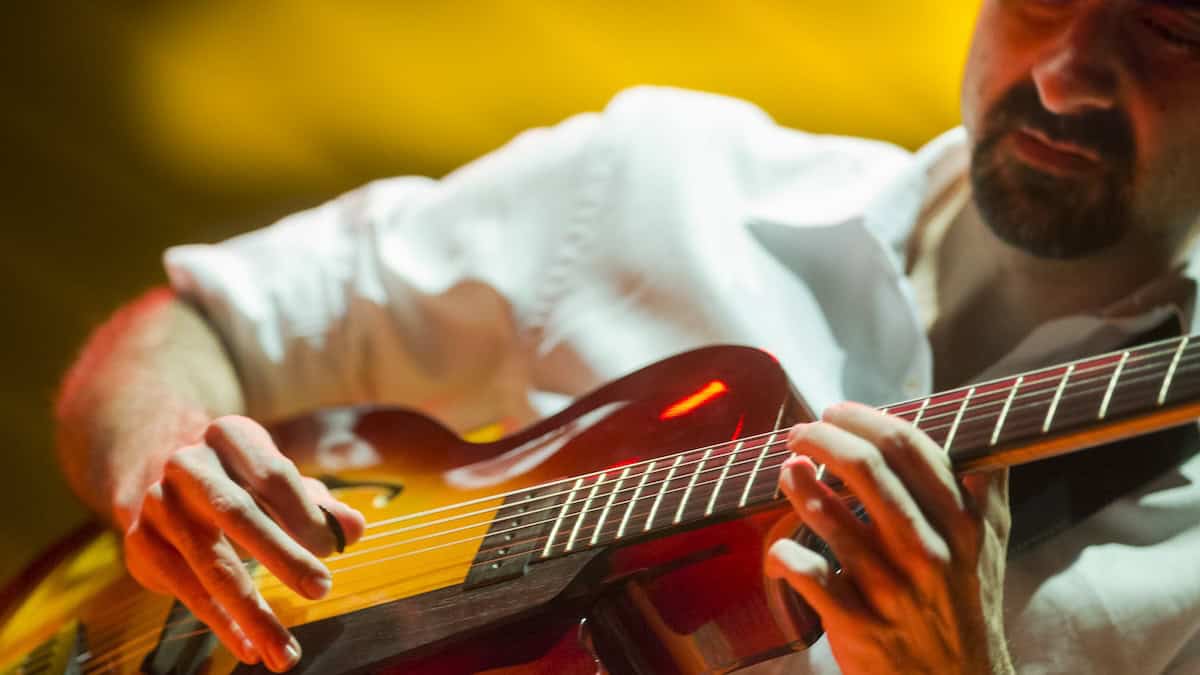
JGT contributor Joe Barth talks to guitarist Yul Ballesteros.
Above photo credit: Nacho González/ Auditorio A.Kraus
Keeping active performing both in Spain and the Canary Islands off the Northwestern African coast is guitarist Yul Ballesteros. Yul enjoys playing combo, solo as well as big band gigs.
JB: Talk about what inspired you to play jazz guitar.
YB: Since I was a kid, I’ve been listening to all kinds of music, most of It with guitar players in It. My family also used to get together and play popular music from the islands with guitars, so I guess, at first, I chose the guitar because It was the instrument I had around. But then, I started to listen to jazz and study the instrument and fell deeply in love with it, with all the harmonic and melodic possibilities that it offered me. I remember listening to Wes (Montgomery), Coltrane, or Miles for the first time and feeling something I never felt before.

Tana Santana – Contrabajo
Akior García – Batería
JB: Talk about the things you appreciated most about your musical studies at the Berklee College of Music.
YB: Berklee is an amazing ecosystem of musicians trying to explore everything related to music. There, you have the chance to learn from a lot of incredible teachers and take advantage of the amazing facilities of the campus. But also you meet a lot of musicians from all over and start to build a worldwide network that brings you not only the chance to make your music grow in quality but also to help you to significantly increase the exposure of everything you create.
JB: To you, what are three of the most influential jazz guitar albums and why?
YB: There are so many guitar albums I love and had big influence on me that it’s really difficult to pick up only three… The first jazz guitar album I bought. The importance of this is the fact that It was the first real approach I had with jazz guitar. The album is Lee Ritenour’s Alive in LA. Nowadays, it’s not the type of jazz I play or listen to anymore, but at that time, It was the perfect beginning for a guy from a place where jazz almost didn’t exist. The “easy harmonies” and amazing technique made me start loving that jazz sound.
Another album that inspired me a lot is Wes Montgomery’s Smokin’ at the Half Note. The sound of Wes’ guitar and the way he plays every perfectly chosen note is the best example of how to swing on the instrument. Also, the way he improvises with chords blew my mind and challenged me to explore deeply the instrument and to try to become a better player.
My last choice is Pat Metheny’s Question & Answer. It is the perfect combination of lyricism, improvisation, and communication between three unique musicians. It reflects the creativity of a style that focuses on what is happening at that particular moment.
JB: Talk about your trio with bassist Tana Santana and drummer Akior Garcia.
YB: I feel really lucky every time I play with them. Not only are we close friends for a long time, but we also understand music similarly. I like to think of a trio as a Unity, something like solo guitar playing, where everything is conceived by one head. Rhythm, harmony, and melody are divided into three parts but sound like a single entity, a single instrument. Akior and Tana are two incredible musicians. We’ve shared the stage countless times, so it’s simple to explore feelings and translate them into sounds, thanks to the degree of communication we have achieved through the years.
JB: Tell us about your goals in making your album Solo and later ALMA.
YB: I have always needed to express myself through the music, it’s like therapy for my brain. Every song in Alma is about something that I experienced personally, something that worried me or made me feel happy. But it is also a way to try to evocate feelings we all experience at some point in our lives. I started to write all that music when my daughter was born a few years ago because it changed everything for me, and the way see the world went upside down. The Solo album was a completely different situation. I’ve been fascinated by solo guitar playing since the first time I heard Joe Pass and always wanted to explore It. For years, I forced myself to work on new arrangements of my favorite standards because I knew if I got better at solo playing, also some of the most important skills in music (rhythm, tempo, technique) would significantly improve. I found myself needing to record some of those arrangements on a CD to share them and be able to play them live.

JB: You have performed with guitarist John Stowell. Talk about those experiences.
YB: John is a big reference in the world of guitar. He’s such a unique player. The way he comps is so inspiring, as well as the way he plays solo guitar. Playing with him is a huge pleasure and a complete learning experience. Last month, we brought him to the Canaries to teach a few Masterclasses for our program at Mousiké (a cycle of recorded lessons that we upload monthly on our YouTube channel) and to play some gigs on different islands. I think we had a great time playing together, and I’m looking forward to doing it again soon.
JB: What do you appreciate most about the Jaen archtop guitar you play?
YB: Jaen archtop guitars are amazing instruments. Fernando, the luthier, loves what he does and cares about every detail. The one I play is my signature model that he designed according to my needs. To me is the perfect combination of sound, beauty, and comfort. I feel so grateful to have this custom-made guitar.
JB: You live in the Canary Islands. As a gigging musician, talk about the jazz scene in central Europe.
YB: It’s complicated to talk about the music scene in Europe since I feel it is a little different in every country, but in general there are a lot of festivals and great clubs to play. In the Canary Islands, we have a huge festival, and thanks to its director Miguel Ramírez, we have seen almost all of the most relevant jazz artists over the last thirty years. I think the same situation happens in a lot of small cities around Europe with beautiful festivals. Also, we have many venues where you can show your work to the public, with many interesting cycles like “Rincón del Jazz” at Alfredo Kraus Auditorium, where every month they host amazing concerts with artists from all over the world. But I think if there is one aspect that really defines the health of a jazz scene, and that’s the clubs. Europe has a lot of great jazz clubs like Ronnie Scott’s in London, Le Duc des Lombard in Paris or the Blue Note Milano, to name a few. But also, we can find a variety of smaller yet committed clubs where the scene grows in quality and quantity. Some of my favorites in Spain are Jimmy Glass Jazz Bar in Valencia, Jazz Filloa in Coruña or Café El Despertar in Madrid. Fortunately, there are plenty of excellent musicians willing to play at every festival or club, which ensures that the scene will continue to grow in the future.
Subscribe to Jazz Guitar Today – it’s FREE!
Thank you for reading this post, don't forget to subscribe!


Vocalist Elina Duni and Guitarist Rob Luft Continue Their Musical Journey

“Along The Low Road” Featuring Guitarist Gustaf Ljunggren

New Vince Lewis Guitar Arrangement, “Anything Goes”

Guitarist Paul Ricci Releases “The Path”

Australian–Canadian Quartet Open Thread Return with Waiting Music

British Smooth-Jazz Guitar Master, Chris Standring

Jazz Guitar Today Lesson: “Pensative”

Saying Goodbye To An Atlanta Jazz Musician, Sal Gentile
Jazz Guitar Today Lesson: “Pensative”
Jazz Guitar Today Lesson: “Central Park West”
New Vince Lewis Guitar Arrangement, “Anything Goes”
New Vince Lewis Guitar Arrangement, “Secret Love”

Jazz Guitarist Eleonora Strino Talks To JGT

More About Just Jazz Guitar Founder, Ed Benson

The Inaugural Downtown NYC JazzFest


