
Artist Features
Interview With Italian Jazz Guitarist Filippo Ieraci

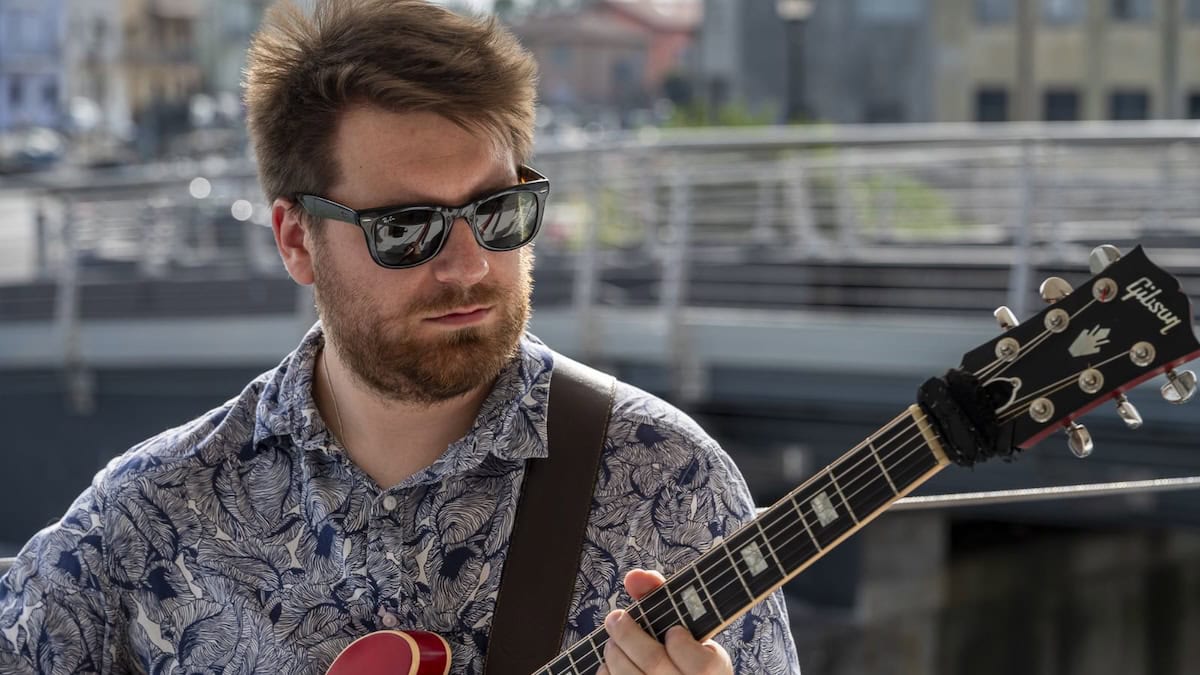
JGT contributor Joe Barth talks to Italian jazz guitarist Filippo Ieraci.
Photo above: Angelo Salvin
British-born and Italian transplant guitarist Filippo Ieraci keeps himself busy in Central and Northern Italy as well as other European countries. In 2021, he was awarded the “Tomorrow’s Jazz Prize,” which is given to promising young musicians.
JB: What did you appreciate most about your musical studies at Maastricht Conservatorium in the Netherlands and then the Conservatorio J. Tomadini in Udine, Italy?
FI: The first music college I went to was the local conservatory in the region where I grew up in northern Italy. The Conservatorio J. Tomadini is lesser known even in Italy I now realize that they have a really impressive faculty, like ECM recording artist Glauco Venier. I later studied in the Netherlands thanks to a student exchange program. During that experience, I feel I grew the most in the shortest amount of time. I felt I had gone to the Netherlands for the primary reason to develop technique, and that is what I did for hours every day. That’s what you should be doing as a student! I also made great connections in the Netherlands/Belgium/Luxembourg area with musicians I still work with today. The schools were great, but I feel there are many ways of learning the theory and mechanics of your instrument. Whilst schools are still an excellent way to learn to play, it is also important to network and learn the culture of jazz/modern improvised music.
JB: To you, what are three of the most influential jazz guitar albums in your personal development and why?
FI: I’ve never been asked this question, so it gave me a good opportunity to think about it, and I narrowed it down to:
The Bridge – Sonny Rollins
This isn’t technically a jazz guitar record, but I feel when you swap piano with guitar in a traditional jazz setting it fundamentally changes the sound of the band, making it centered around the fact that guitar has somewhat less complex harmonic possibilities and dynamic range. Sonny Rollins knew this, and it is for this very reason he chose to play with guitarists for most of his career. I go back to this album regularly and always find it to be a user manual to comping. Jim Hall never used “rocket-science” voicings, but comping is so much more than that! It’s the interaction and orchestration of the soloist’s melody and Jim Hall does that exquisitely!
Intuit – Kurt Rosenwinkel
Kurt’s music is incredibly important and influential to me, but this one was the first album I heard and owned, so I listened to it countless times. Growing up in Europe, it wasn’t that easy to get an idea of what was going on in the contemporary jazz scene unless you knew what to look for. So to me, as a kid, “jazz” was a handful of wonderful albums my parents had (for example, Miles Davis’ Kind of Blue, and Bitches Brew, Monk’s Genius of Modern Music, or Charles Mingus’ Ah Um) but I had no idea if it was still being performed and still thriving. When I heard Kurt, I was like, “Wait, jazz today sounds like this!”. I remember finding the chart to the George Sharing tune “Conception” that Kurt plays on this record and thinking, “No, I’m going to learn this in a couple of years.” I just didn’t understand the changes or how anyone could improvise anything meaningful over them.
– A Go Go – John Scofield
This was one I discovered during one of my first years in music school. I fell in and out of love with this kind of music, but now I don’t think I’ll ever go more than a couple of months without listening to it. At times I used to feel I wanted my phrasing to exclusively be in the modern jazz style with bebop roots, so I didn’t resonate with Scofield’s bluesy bendy stuff. But I’ve since embraced and love the electric guitar and everything it stands for. I fell in love with Jimmy Page and Jimi Hendrix, and how that stuff sticks with you. This is something I thought about a lot when writing the music for my debut album, Trust the Process.
JB: You have worked with John Stowell. Talk about the musical relationship you have with John.
FI: I met John in 2012. I had just finished high school and had gotten accepted into music school. My teacher at the time was Marko Cepak, who John still plays with, and Marko had put together a masterclass quite close to where I grew up. I remember I’d brought a pen and pad and was frantically writing everything down and thinking, “Write everything he says and figure out what it means later,” so I went home and did that. John, among many other things, speaks about what harmonic possibilities one has over chords, so how can we substitute the conventional scale related to the chord with something else? Since then, we’ve been regularly catching up and trying to get a gig any time he’s in the area.
JB: You have some CDs out. Tell us about your newest, Trust the Process.
FI: I recorded Trust the Process in June 2023 with bassist Simone Serafini and drummer Jacopo Zanette. Both are great local musicians from my area. Trust the Process is an invitation and a reminder to have the courage to undertake your own personal journey of life. We tend to seek shelter and comfort in the ideal of life that we observe around us, and today, because of social media, I find it increasingly difficult to escape the inevitable temptation to compare myself with artists and people around me.
JB: Tell us how your musical partner in Cucumber Green, bassist Eugenio Dreas, musically draws out from you what other musicians may inspire differently in you.
FI: Eugenio and I were housemates during music school, so I’ve known him for quite a while now. I just find it’s easy to work with him, and I enjoy it so much that it doesn’t feel like work at all. We have very similar ideas of what we musically want for this project, and we have a very similar background in regards to what music influenced us. Working with someone you know makes it easier to write music for the person specifically. In Cucumber Green, both musicians are composers and arrangers, and the goal of the project is to evoke the sounds of music from the 60s and 70s.
JB: It looks like you play a Telecaster and a Gibson 335. What do you appreciate most about your main guitars?
FI: I have a Telecaster Thinline, a Gibson 339, which is the same as a 335 but smaller, and I also have an American Stratocaster. My Thinline originally had Fender wide-range pickups but after I got my Gibson I found the two guitars to be too similar sounding. So, I swapped the Tele’s wide ranges out for a pair of Seymour Duncan Fat Cats. These are P90s designed to fit in a humbucker space. Little did I know the wide-range pickups are larger than humbuckers so I had to have a new pickguard specially made. I do love the way it sounds now. I love my guitars because I feel they range beautifully from bright and twangy to dark and meaty with the P90s as the in-between sound. My Tele was my dream guitar.
JB: As a gigging musician, talk about the jazz scene in Milan and Italy.
FI: The gigging scene in Italy is not in its best shape. I remember during my years in music school (so not that long ago) there were three good-level jam sessions per week in my region alone. Unfortunately, places either shut down or converted to fancy gin bars for tourists who would rather either have music playing on the PA or maybe a DJ. I hear the same story in most places in northern Italy. I guess Milan is so big and full of people, clubs, and events that the scene is doing ok there, but as far as I know, it’s mostly music for corporate events and not so much creative music. I would like to be positive and invite everyone to come play in Italy, but I don’t really feel the scene is at its best right now. I hope things change quickly.
JB: What advice would you give young American musicians who want to play gigs in Northern Europe?
FI: I would say make personal connections with people and organize a small tour of a handful of gigs. This is what I see most people do, and I do it myself with friends I have from abroad. Everyone who plays music should have a good club or bar in mind where to get a quick gig if a friend is trying to put together a tour. Money-wise, try to break even but don’t expect to hit it big time by playing clubs. But, things happen if we travel, play, meet people, and hang out after concerts. So, who knows? Then the next tour might be longer, with better conditions, next time around you might get a small theatre.
Subscribe to Jazz Guitar Today – it’s FREE!
Thank you for reading this post, don't forget to subscribe!


Vocalist Elina Duni and Guitarist Rob Luft Continue Their Musical Journey

“Along The Low Road” Featuring Guitarist Gustaf Ljunggren

New Vince Lewis Guitar Arrangement, “Anything Goes”

Guitarist Paul Ricci Releases “The Path”

Australian–Canadian Quartet Open Thread Return with Waiting Music

British Smooth-Jazz Guitar Master, Chris Standring

Jazz Guitar Today Lesson: “Pensative”

Saying Goodbye To An Atlanta Jazz Musician, Sal Gentile
Jazz Guitar Today Lesson: “Pensative”
Jazz Guitar Today Lesson: “Central Park West”
Jazz Guitar Today Lesson: “All or Nothing at All”
New Vince Lewis Guitar Arrangement, “Anything Goes”
New Vince Lewis Guitar Arrangement, “Secret Love”

Jazz Guitarist Eleonora Strino Talks To JGT

More About Just Jazz Guitar Founder, Ed Benson

The Inaugural Downtown NYC JazzFest
-
 Jazz Guitar Lessons1 week ago
Jazz Guitar Today Lesson: “Pensative”
-
Jazz Guitar Lessons3 weeks ago
Jazz Guitar Today Lesson: “Central Park West”
-
 Jazz Guitar Lessons1 day ago
New Vince Lewis Guitar Arrangement, “Anything Goes”
-
Jazz Guitar Lessons4 weeks ago
New Vince Lewis Guitar Arrangement, “Secret Love”