
Artist Features
Guitarist Socrates Garcia Composes New Album, Shadows of Tomorrow

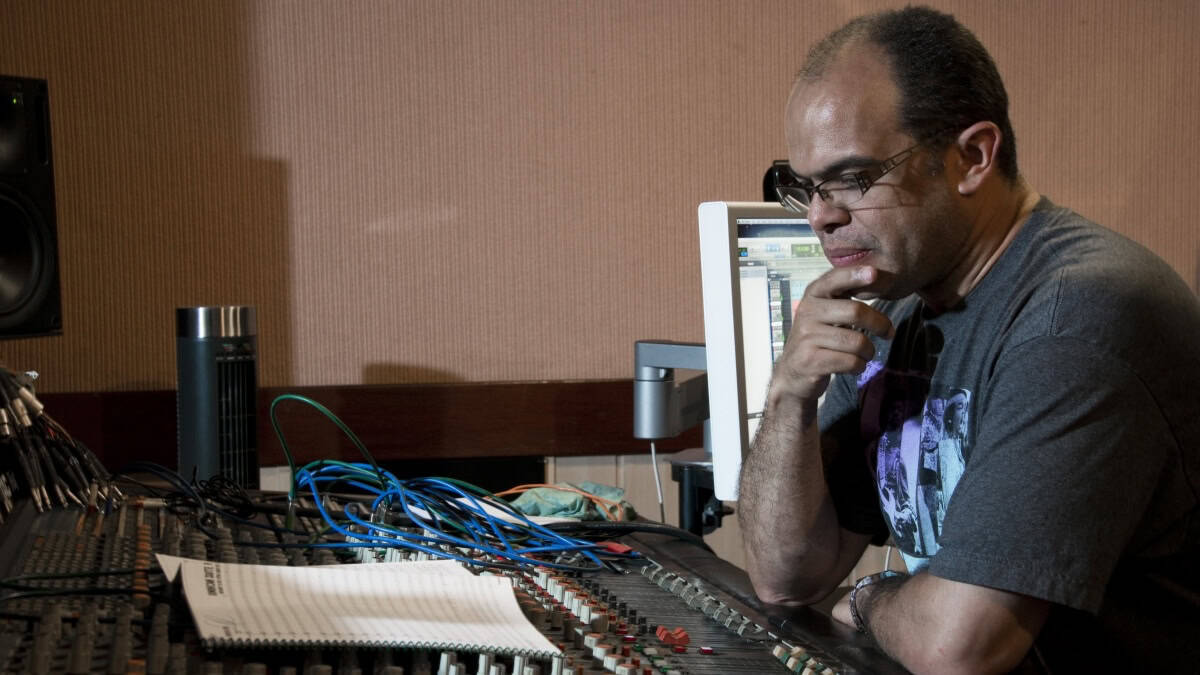
JGT contributor Joe Barth talks with guitarist Socrates Garcia about his new album, Shadows of Tomorrow.
Busy in the greater Denver area, Socrates Garcia is an in-demand guitarist, composer/arranger, and teacher. He is a full professor of jazz music at the University of Northern Colorado in Greenly, Colorado. On his newest CD, Shadows of Tomorrow, he has put down his guitar and picked up his composer’s pen and his conductor’s baton. I asked Dr. Garcia about this new recording.

JB: Before I ask about the new Shadows of Tomorrow album, tell us, to you, what are three of the most influential jazz guitar albums in your personal development as a guitarist, and why?
SG: It’s really hard to narrow it down to just three, but here we go.
The Great Explorers – Frank Gambale / Metal Fatigue – Allan Holdsworth
I know, that’s two, but I honestly can’t separate their influence on my playing. These albums were my introduction to fusion guitar and really opened the door to jazz for me. I have studied a lot of Frank’s educational materials, and he has been a significant influence. I never got to meet Allan, but I was fortunate to become friends with Frank, and his musicianship is truly extraordinary; he is the real deal.
Smokin’ at the Half Note – Wes Montgomery
In my opinion, this is the best jazz guitar album ever made. It’s a masterpiece, basically an encyclopedia of musical ideas. I remember transcribing several of those solos, and I still listen to this album regularly.
El Hombre – Pat Martino
To me, Martino feels like a natural evolution from Wes. His playing on this record is incredible, and his version of “Just Friends” is a masterclass in jazz guitar. The tone, the touch…it’s all there. Martino’s solo on “Just Friends” was one of the first jazz solos I transcribed/learned.
JB: What do you find rewarding about working with a Latin Jazz Orchestra with the extra percussion players?
SG: I’ve loved the sound of the big band ever since I was introduced to it at 19, when I was the guitarist in the Santo Domingo National Conservatory of Music’s jazz big band. At the same time, I was writing a lot of commercial music—everything from metal and pop to different Latin styles, so I was always moving between worlds.
When I moved to the U.S. to pursue my degrees, my writing leaned more toward a traditional jazz approach. That’s when I started learning about composers like Maria Schneider, Jim McNeely, and Fred Sturm, who became my mentor and a huge influence. Their work had a big impact on how I thought about writing for large ensembles.
In 2008, while I was working on my master’s at Middle Tennessee State University, my professor Jamey Simmons asked me a simple but heavy question: “What is new that you bring to the table?” That question stuck with me for years. It wasn’t until I was choosing a topic for my doctoral dissertation that it finally clicked: what if I fused my heritage with the contemporary jazz language I had been developing?
Once that idea landed, everything started falling into place: the melodic phrasing, the rhythmic approach, and the instrumentation. On both SGLJO albums and in our live performances, the percussion section, including the drum set, comprises Dominican musicians who deeply understand the rhythmic complexity of Dominican and Caribbean genres, as well as the nuances of jazz. That authenticity makes all the difference.
For me, the most rewarding part is the sheer power of the extended ensemble, and that moment when you hear a new piece for the first time with the full band, especially with the percussionists. I’ve been incredibly lucky to collaborate with amazing musicians in both the U.S. and the Dominican Republic, which gives me total confidence as a composer. I know that when they play the music, it’s going to sound even better than what I imagined or what I saw on the page.
JB: Talk about the first track, “AG’s Resting Face….Scary,” and why you began the album with this song?
SG: This is a piece I wrote and ended up naming after my daughter, Astrid. It’s basically my way of describing her as a teenager, you know, the classic one-word answers to everything: yes or no, no explanation, and always with that totally straight face. Fortunately, we’re past that phase now.
The piece was commissioned for the UNC Jazz Festival All-Stars during the COVID years. I chose it as the opener because it really brings together a lot of my influences: metal guitar textures, merengue rhythms and percussion, and of course all the jazz harmony, phrasing, and language that I work with. It just felt like a strong way to set the tone for the record.
I’ll admit, I went back and forth for a while between this one and “Sultry Villa Mella Twilights” as the opener, but in the end this piece felt like the most natural way to introduce the whole project.
JB: The album consists of all original songs that you arranged for big band. Did you compose this music for this particular project?
SG: Yes, all of the pieces were written with this album in mind. That said, two of them were originally commissioned projects: “AG’s Resting Face…Scary!!!” was commissioned by the University of Northern Colorado, and “The Wizard’s Wicked Charm,” the first movement of the suite Illusions, Delusions…A Glimmer of Hope was commissioned by Vanderbilt University.
All of the music on the album was composed, arranged, and conducted by me. I also recorded a few overdub sessions and mixed the entire record. The full band tracking sessions and the mastering were done by Greg Heimbecker.
JB: What do you find most rewarding about composing, arranging, and conducting that is different than playing your guitar?
SG: I enjoy both recording and mixing, in addition to engineering and, of course, teaching. They are all part of the whole, I can no longer separate.
Playing guitar is really immediate for me, it has been a big part of my identity since I was a little kid. It’s physical, it’s emotional, and it’s very much about the moment. You play something, and you feel it right away, which I truly love.
Composing, arranging, and conducting are different because they allow me to step back. I’m not just thinking about my part but about the whole picture. The form, the textures, how the energy moves, how harmonies/melodies and rhythms connect over time.
I really enjoy hearing ideas that started in my head come back through other musicians’ interpretations. This ties up with your previous question about the rewards of working with the large Latin ensemble. When you’re playing guitar, the expression comes straight from your hands. When you’re leading a group, the music comes from people, and that’s a whole different kind of reward. Everyone adds something, and suddenly it’s way bigger than anything I could do on my own.
So, for me, guitar is about personal expression and composing and conducting are about vision and collaboration. I need both, but I really love watching an idea turn into something collective.
JB: You recorded this in Colorado. I can’t ask about every soloist, but tell us about your musical relationship with Pittsburgh saxophonist Don Aliquo, who plays several great solos on the recording.
SG: He played some incredible solos on this album, indeed. He literally flew to Colorado the day of the recording and left right after we tracked the last tune, which says a lot about his commitment. I really appreciate the effort he made to be there and make it work.
Don and I go way back. He was the director of the jazz program at MTSU and my professor, and since then, he’s been a strong supporter of my music and projects. He’s someone I admire deeply, not just as a mentor, but as a musician and close friend. He’s a monster player, a complete artist!
Thank you for reading this post, don't forget to subscribe!


Australian–Canadian Quartet Open Thread Return with Waiting Music

British Smooth-Jazz Guitar Master, Chris Standring

Jazz Guitar Today Lesson: “Pensative”

Saying Goodbye To An Atlanta Jazz Musician, Sal Gentile

Julian Coryell Brings New Flavors of Flamenco, Gypsy, Latin and Jazz to the Tonalic Library

Australian Guitarist Zak Scerri Debuts London Trio Album

Jazz Guitar in Tasmania… and New York City

Greek Bouzouki Virtuoso and Jazz Guitarist, Michael Paouris
Jazz Guitar Today Lesson: “Pensative”
Jazz Guitar Today Lesson: “Central Park West”
Jazz Guitar Today Lesson: “All or Nothing at All”

New Vince Lewis Guitar Arrangement, “Secret Love”

Jazz Guitarist Eleonora Strino Talks To JGT

First Time In The US! Eleonora Strino

More About Just Jazz Guitar Founder, Ed Benson


