
Artist Features
Guitarist Jon Dalton Talks to JGT About His New Album, “Carousel”

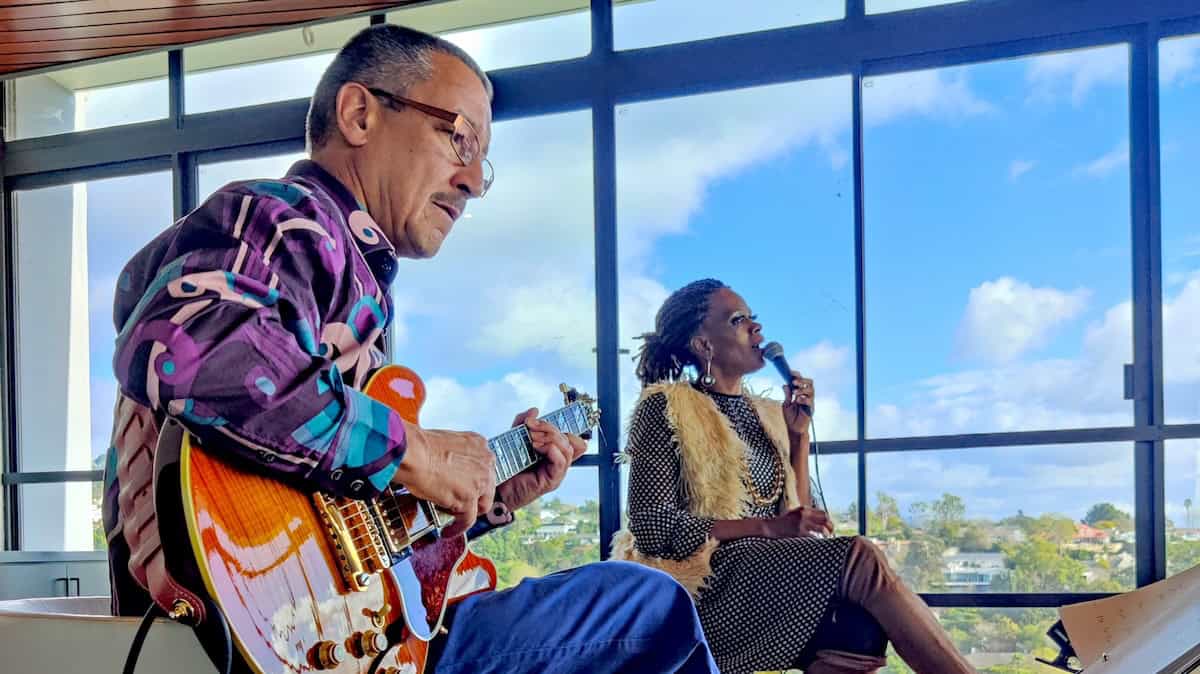
JGT contributor Joe Barth interviews West LA area guitarist Jon Dalton about his approach to the guitar and the new album.
Gigging around the West L.A. area of Venice Beach is guitarist Jon Dalton. Jon has just released a new album Carousel.
JB: You haven’t been featured in JAZZ GUITAR TODAY. So, before I ask about the new album, tell me about yourself. Born in England, when did you start to play jazz guitar and what was most helpful in your personal development as a guitarist?
JD: I developed a taste for jazz guitar in my late teens after seeing players like Joe Pass and Herb Ellis on TV. I didn’t know the first thing about jazz guitar even though I had already been playing rock and pop for several years. That said, I did recognize a lot of the tunes they were playing because my mum used to sing them as the pop songs she heard when she was growing up in the 1940s and 50s. Luckily, she had a fine voice and perfect relative pitch, so I learned the intricacies of songs like “All The Things You Are” and “Stardust” nearly two decades before I ever tried to play them. I got my first full-time, professional gig playing contemporary Top 40 material in dance clubs in Scandinavia. It was hard work, four, five sometimes even six sets per night but it taught me a lot about stamina, perseverance, and how to keep people dancing, that was so invaluable in developing an appreciation of the groove.
That work kept me busy for almost ten years, so I was in my late twenties before I started learning jazz guitar in earnest. I ditched the ES-335 and went to a full size archtop, flat-wound strings, no bending, the full works.
JB: What are three of the most influential jazz guitar albums to you and why?
JD: Number one would be Wes Montgomery’s Boss Guitar. That had everything I love about jazz guitar all rolled into one. The playing is, of course, exemplary but the groove and grit are what really makes it for me. “Days of Wine and Roses” had me almost crawling up the walls trying to hold on; it’s that beautiful. The whole album catches a certain 1960s sense of style and optimism. More and more people were traveling and enjoying new experiences. The way the guitar and organ solos soar just puts it all into perspective.
Number two Is Pat Martino’s Live at Yoshi’s. That’s a favorite for so many reasons. Another organ trio record. It has a direct connection to some of my earliest musical experiences.
Although it’s taken to a whole new level here, there’s a familiarity in the music of Martino, DeFrancesco and Hart. I know that Pat Martino got his earliest experiences playing hours-long sets in jazz-dance clubs and it really shows. Although the music is harmonically very sophisticated at times, it just burns with groove and intensity.
Number three is Pat Metheny’s Offramp. That’s a difficult choice because I admire so many recordings. I lived through the Jazz Rock & Fusion years. There was some undeniably fantastic music but it was often very charging and frenetic. As soon as I heard this, I recognized the melodic jazz guitar sound. Although he used delay effects and guitar synthesizers, I could hear at the core that same ES-175 fat jazz tone I could trace back to my earliest memories of Joe Pass, Herb Ellis, Barney Kessel, et al. I loved that sense of continuity. It also allowed me to delve into that sound again, which I appreciated. Then there’s the writing and tunesmithing. That’s an aspect of music that’s often overlooked but I think that he, in concert with Lyle Mays, was a real dream team that took a form and rebuilt it into a new and recognizable modern language.

JB: You moved to the United States in 1999. Was it because of a music opportunity?
JD: Yes and no! My Great-Grandfather was from the US but settled in England in the early 1900s. He was mixed-race black and Native American, not uncommon in the South back then. He couldn’t do what he wanted to do in America, so he found a way to leave. He was pretty tenacious. I love the UK and have many good friends still there but I never felt completely at home.
Of course, the music was an equally strong factor, everything was sort of intertwined. As long as I can remember, people thought I had an “American” sound. It wasn’t self-conscious, it just turned out that way. My first Album, The Gift did really well for me and helped me get a foothold in the US. It was hard to get established at first but I’m feeling more like part of the furniture as time moves on!
JB: Talk about your musical relationship with the late guitarist Barry Zweig.
JD: One night we were out on Windward Avenue in Venice Beach and we decided to go into the Townhouse which has an old speakeasy in the basement. As we were walking down the stairs, I picked up the sound of some classic jazz guitar. At first, I thought it was a record but, when I saw the stage and the players and heard the music, I knew this was the real deal. We sat there in delight and would return to hear them time and time again. I eventually summoned up the courage to say hello to Barry and he was the sweetest guy. He came to my house for a jam, and even came to one of my gigs. He was very encouraging, and we stayed in contact until he passed. He worked hard and shone a light. He was humble and brilliant.
JB: The new album Carousel I believe was recorded over a long period of time. “Spaceship Orion,” Out of the River” and “It Got Stuck” are quite pop-orientated. “Smile of the Beyond” is quite Eastern. The Standards and other originals are straight-ahead jazz. Reflect upon the material selection for the recording.
JD: There was never actually a plan to make another album. I met Sheila Ellis who is a fine vocalist native to Los Angeles while working for a charitable music organization in L.A. It turned out her husband, the producer Richard E. had also grown up in the UK, albeit at the opposite end of the country to me. I mentioned some ideas I had like trying to transcribe Mahavishnu’s “Smile of the Beyond” from an orchestral piece to a band setting and my first drafts of The Carousel which I’d composed but couldn’t figure out how to solo over. They both just looked at me and said, “OK”?
What Richard E. said was a good enough reason to keep going. I’d been playing jazz guitar for over thirty years; that’s where the bulk of my inspiration comes from, but I also had an affinity with many other styles and Richard encouraged me not to hide that. He and I would often spend hours on the phone at night figuring out what to do and how to do it and eventually, the album began to take shape.
There’s a lot of variation and difference. I could have taken the rest of the tracks and compartmentalized them into different projects but I figured it’s all part of my life and musical experience so why not just tell it like it is?
JB: When playing jazz, what is your guitar of choice and why?
JD: I used to favor large archtops like the Gibson ES-175, 1989 Washburn J-10 and even a Gibson L-5 Wes Montgomery but, shortly after he passed, I saw a Gibson Pat Martino for sale, and I bought it. I was mainly thinking of the guitar as a memento or a keepsake but once it arrived, I realized this was a guitar that was meant to be played. The body is fairly compact and made of a block of solid mahogany with carved acoustic chambers. It’s overlaid with a flamed maple cap and looks a little like an oversized semi-acoustic Les Paul but it’s completely its own animal. The sound is fat like a full hollow body and there’s a pronounced thump behind each note. The note volume is completely even top-to-bottom so you don’t get fatigued by making constant micro-adjustments to achieve a smooth tone. Also, it has a compound radius fretboard that is rounder at the nut end and flattens out toward the body. You don’t really see it but it just makes it effortless to play. If ever I hand it to another player, regardless of skill level, they always find themselves experimenting and exploring new things.
A little later I found a Gibson Paul Jackson Jr. which I think is by the same designer and has many similarities. It had been played a lot and was nicely worn in. That’s become my go-to daily guitar for instrumental playing. I keep the Pat Martino for especially challenging things. I think of it as a musical slide rule. I used it to record the track “The Carousel” which had been foxing me for years. That guitar helped me figure it out.
I must also mention my cherry-finish Gibson ES-345. It’s a Nashville Custom Shop mono model from around 2000. It had received the full Marty McFly “Back To The Future” treatment: Bigsby tremolo, bridge studs left in, and was in pretty poor shape. I wasn’t sure I even wanted it, but I was offered at a really great deal and I walked away with it.
You live in the Venice Beach area of Los Angeles. Talk about the gigs you do and how you make a career in music work for you.
L.A. isn’t really a jazz town. Honestly, if you really want a career focused solely on jazz guitar, New York or even Europe and Scandinavia might be a better choice. That’s not to say there isn’t a great jazz guitar scene here and some excellent players, but you need to be flexible to stay on top of things. If you’re a good reader (which I’m not) you can find work in the film and TV world. I do quite a lot of sessions where I’m called to create something new out of whole cloth. Someone might want a smooth jazz sound or an indie pop feel or even some psychedelic rock. I throw myself into it because you never know where that may lead. A lot of Angelenos have theatrical training so they can act, sing, dance, and play, all to a high standard. I’ve found myself called to do one thing and, once they find out I’m a jazz guitar player they put me to work doing something else. I had a near two-year residency playing straight-ahead in a restaurant in Santa Monica which hardly ever happens here. Last year, Sheila and I were a semi-resident duo in two renowned L.A. hotels and a great restaurant out in Palm Springs. We’ve just completed our own individual projects so we’re about to start that up again. Recently, I’ve been playing with a fine jazz guitarist Matt Aschkynazo and we’re sharing each other’s repertoire. Hopefully, we’ll be a gigging duo soon. and, of course, now the new album’s out I need to pull together a band to showcase it.
Subscribe to Jazz Guitar Today – it’s FREE!
Thank you for reading this post, don't forget to subscribe!


Nexus From Guitarist Jordi Farres

New Vince Lewis Guitar Arrangement, “What The World Needs Now”

Veda & The String Machine’s New Album, Rise And Shine

New Recording From Guitarist Doug MacDonald, Tribute To South Central

Joe Negri Dies Just 10 Days before His 100th Birthday

Jazz Guitar Today Lesson: Variations On Standard Jazz Blues Chord Changes – Part 2

Guitar Great Ron Eschete’ Dies at age 77

One of Chile’s Finest Fingerstyle Guitarists, German Herlein
Jazz Guitar Today Lesson: Variations On Standard Jazz Blues Chord Changes – Part 2
Jazz Guitar Today Lesson: Variations On Standard Jazz Blues Chord Changes – Part 1
Jazz Guitar Today Lesson: “Pensative”
Jazz Guitar Today Lesson: “Central Park West”
New Vince Lewis Guitar Arrangement, “What The World Needs Now”
New Vince Lewis Guitar Arrangement, “Anything Goes”

Saying Goodbye To An Atlanta Jazz Musician, Sal Gentile

Jazz Guitarist Eleonora Strino Talks To JGT
-
 Jazz Guitar Lessons9 hours ago
Jazz Guitar Today Lesson: Variations On Standard Jazz Blues Chord Changes – Part 2
-
Jazz Guitar Lessons2 weeks ago
Jazz Guitar Today Lesson: Variations On Standard Jazz Blues Chord Changes – Part 1
-

 Jazz Guitar Lessons7 hours ago
New Vince Lewis Guitar Arrangement, “What The World Needs Now”
-
Artist News2 weeks ago
Guitar Great Ron Eschete’ Dies at age 77

