
Artist Features
Remembering John Pisano

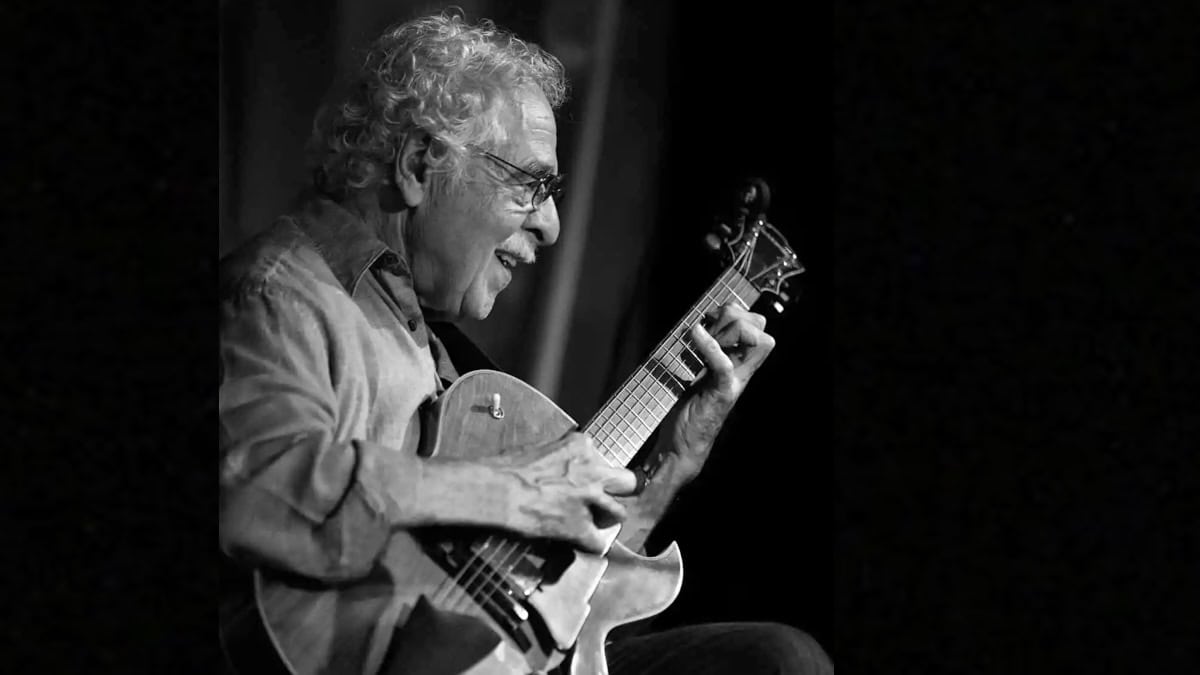
Ten years before his death last May, Joe Barth met with John at his Laurel Canyon home to talk about some of the “greats” of jazz guitar.
Photo above – Bob Barry
John Pisano is a walking history of jazz music. He has played with so many great jazz artists over the years from Benny Goodman, Chico Hamilton to Diana Krall. He was part of the guitar nights at Donte’s in North Hollywood and assumed them when Donte’s closed to where they continue to this day in the Burbank area of Los Angeles. Doctoral students write their dissertations on the For Django album that he did with Joe Pass. John grew up on Staten Island, New York, and moved West, making Los Angeles his home for years. Ten years before his death last May, I met John at his Laurel Canyon home to talk about some of the “greats” of jazz guitar.
Kenny Burrell is one of my favorites. I first met him at the Newport Jazz Festival in 1958. He is the only guitarist who recorded with John Coltrane. Kenny was one of the first guitarists to sound like a horn player. Before him, guitarists sounded guitaristic when they soloed. Even though we both live here in L.A. I don’t see him all that often.
I first met Herb Ellis in Chicago in about 1957. I was with Chico Hamilton, and Herb was with Oscar Peterson. I was one of the first guitarists to move to Los Angeles, and there was a lot of studio work here in those days. When Herbie decided to relocate here, he called me saying he was in town and if I knew of extra studio work, could I please direct it his way. Herb did the Carol Burnett Show for a lot of years.
Herb’s roots in Texas always stood out with the bluesy sound. He is a little like Barney Kessel. Being with Oscar, he had impeccable time. He did such great technical stuff with Oscar. He and I would always talk about Freddie Green because Freddie was tops as a rhythm guitarist.
In Herb’s later years, when Barney and Charlie Byrd could not do Great Guitars, I did two tours of Europe with Herb and Mundell Lowe as The Great Guitars. What fun it was to have that time and travel with Herb and Mundell. They both go back to Charlie Christian.
Freddie Green is the ultimate rhythm player. No one plays like him. Bucky Pizzarelli comes closest to Freddie’s time and sound. Please receive this in the right spirit, I know that I am a pretty decent rhythm player. I have done it for years. When I teach, I find it interesting that students ask me, “How can I play so much rhythm guitar?” When I was their age, that is what everybody did. There were lots of rhythm gigs. It was all around you, and you had to learn how to play rhythm well. There were a lot of great rhythm guitar players in those days.
One time, I went to Disneyland when the Basie Band was playing there. I stood there watching Freddie play that Gretsch with those high strings he had. I asked him at break how he could play with his strings so high, and he said, “You have to get used to it.” (laughter) That’s Freddie! You know, he was the one who held that rhythm section together. To play rhythm with a big band is hard. At the end of the gig, you were really tired.
George Van Eps is something else. What a contribution he made to jazz guitar. The first time I saw him, I was with Chico’s band and we were at the Columbia studio. At the break I saw George talking with someone, and my heart started pounding and I was afraid to go up but I did to say hello. I said to him “The Mellow Guitar album you just did is one of my favorites,” and he said “ Oh, you really like THAT?” (laughter) I took a couple of lessons from him. George would occasionally come to my house. I called him to do the Guitar Night a couple of times.
Howard Alden has done a lot of Guitar Nights with me. He loves doing Guitar Night. He is a wonderful guitar player who knows hundreds of tunes and plays all the right changes with them. He has that banjo technique that is so wonderful.
Charlie Christian is not only a breakthrough for the guitar as a soloist. I mean, there was Django. But Charlie was also one of the first guys to play horn-like lines. Charlie and Django idolized each other. Those older guitar players had a very arpeggio-saturated way of soloing. What an influence he had on the development of the electric guitar.
(Anthony Wilson) I did an album with Diana Krall right before the Paris Concert that had a lot of nylon guitar. I got the call from Dori Caymmi to go over to Capitol Records on a Sunday night. Dori was doing the session with Claus Ogerman, the arranger, whom I loved from his work with Frank Sinatra, and Dori doesn’t read chord symbols all that well. Chord symbols are written differently in different parts of the world. I get to the studio, and Dori had scribbled and marked up the charts with what he thought the chords were! (laughter) Claus was happy with what I did, and so we started to do the two takes. It was just the rhythm section in the studio, and Claus was going to do the string parts the next day. You know you have to be very careful and conservative in those settings because you don’t want to do anything that will clash with what the arranger has written for the strings. Diana had me do the Tonight Show with her, and then later I got the call to do the Live in Paris album and DVD.
That Live in Paris was the first gig that Anthony Wilson did with her. I was going to play just nylon string guitar for this, and Tommy LaPuma, her producer, called me and asked that I also bring my electric archtop just in case. I knew Tommy for years from our A&M days, and I said, “Tommy, I have heard Anthony play, and he is going to do just fine.” Tommy said, “Bring it anyway.” (laughter) At the first rehearsal, Anthony played those arrangements like he had done them for years. At break, I went over to Tommy and said, “And you made me carry two guitars on the plane!” (laughter) Anthony is one of my favorite players. He has such a great ear. He did the Guitar Night a month or so ago.
Django Reinhardt was my influence. My nickname was Django because I had all his albums. At age fifteen, I was playing all the Django licks. I saw him in New York with Duke’s Orchestra in 1946. He played only the second half of the concert. I think he was scheduled for the first half, but he was often late and forgot about his commitments to do shows. Duke introduced him, and he came out on stage with a new Gibson, probably right out of the box with loose strings, and so there he is tuning the guitar up to pitch on stage. (laughter) He was my idol, and I knew his recordings so well that simply seeing those two fingers move across the fingerboard was mesmerizing. I can see it in my mind now, like it was yesterday.
Barney Kessel was a funny guy. In those days, there would always be four or five guitar players on a session, and I would always run into Barney at a session. Later, I was playing at Donte’s, and Barney was there all night listening to me. Afterward, he came up to me and said, “John, I really like the way you play, and would you work with me?” So, some dates were scheduled. About the time we were to do the dates, Peggy Lee called me from Chicago and said she had fired three guitar players and would I please come and play with her. So, I went to Chicago and wasn’t able to play those dates with Barney.
After Charlie Byrd died, we did a memorial concert for him, and Barney was able to come with his wife Phyllis, even though he had his stroke. Barney took jazz guitar to new levels in rhythmic playing. He also used such interesting chord melodies.
Howard Roberts was the only guy who was doing back-picking, or what they call sweeping now. Chuck Wayne taught me how to play that way. Howard used a lot of finger movement. He watched me one time all night and told me that I’m a heck of a guitar player. I did a lot of recording sessions with Howard. He invited me to play rhythm on one of his albums.
Mundell Lowe is one of the most melodic players. His playing is unusually great harmonically because he was such a great arranger. He had a lot of technique when he was a younger player. He is still a great player at 93, but he is losing his vision and sometimes has a hard time seeing where he is placing his fingers on the neck. He has done the Guitar Night with me a number of times.
(Joe Pass). I sure miss him. We spent a lot of time together. He came to the house for dinner quite often. I met Joe when I called him to sub for me on a Page Cavanaugh gig. I was also playing with Peggy Lee then, and Joe would sub for me when I was on the road with Peggy. Later, he invited me down for some jam sessions at Synanon. After getting rid of drugs, he looked to me on how a musician is to live a clean, productive life. The For Django album came about after we did this album of movie themes, where we played a 12-string guitar. A different but interesting album. Joe wanted to do a quartet album next, so we got Colin Bailey on drums and Jim Hughart on bass as our rhythm section. His idea was to make an album and dedicate it to Django. Joe hated to rehearse, but we did rehearse for this session, and Joe and I worked on these nice duet lines. But on the original release, my lines were way too low in volume on the mix. On the Mosaic box set, they fixed that. That is a special album. It has become kind of a “Bible” of jazz guitar.
As a solo guitar player Joe had this amazing ability to play with a modern voice. Of course, George Van Eps and others played solo guitar before him, but he was just so spontaneous and fresh when he played solo guitar. He never worked anything out ahead of time. He would place his hands on the neck, and he had what he called “grips,” and he would start playing. One night I saw him do a solo set, and he was so “on.” It was just great! I said to him afterward how great he was, and he replied, “John, you could do the same thing.” I said, “Right.” He said, “But I have more ‘grips’ than you.” (laughter)
He was always getting bored with himself, and so he would just change key, and that would sometimes put the melody in an awkward place, but he would work things out for himself. The audience loved how he would take these chances and be on the edge of their seat, wondering how he was going to get out of this one. In starting a tune, he would choose what key he was going to play the song in based on where his fingers landed on the neck. We were very good friends.
(Billy Bean). Billy and I recorded in my mom’s kitchen on Staten Island in New York. That was the first time I met Billy. I bought a Charlie Ventura album that had the pianist Dave McKenna, whom I liked, and the guitar player, Billy Bean. When I heard it, I fell in love with Billy’s playing. He played jazz guitar in the way that I always wanted to play. I met him, and he was open to coming to my mom’s to play together. It was soon after that that we got the call that the record company wanted to do an album with Billy and me, with some orchestrations.
He was a sweet guy when he was sober, but he was a very difficult person when he was drinking. Whenever I got back East, I would call him. One night in Philly, he came over, but he wanted to drink, and that was difficult. In those later years, I asked him about the guitar, and he said that he had just lost interest in the guitar. Sad…
Jim Hall is a great player. I followed him in Chico Hamilton’s band. Paul Horn recommended me to Chico. When Jim left L.A. and moved back East, I would get his calls for gigs, and I ended up playing in a number of settings that he would have played here in L.A. if he had not moved. For example, I played in the Jimmy Giuffre Three. He didn’t get crazy in his playing. He had chops, but he never flaunted them. What wonderful harmonies and space in his playing. The last time I saw him, he was at the Jazz Bakery here in L.A.
Gene Bertoncini has been to the Guitar Night quite a few times and always stays at my house. He studied with Chuck Wayne as well. He is unique in how he creates space in his music. He uses such inimitable voicings. He has the most creative rendition of “Body and Soul.”
Jack Wilkins is quite the player. He has a tremendous right hand. We talk on the phone from time to time. He is not known as well as he should be.
(Lee Ritenour) I haven’t heard Lee play like that. Years ago Lee and I played a duo gig at Donte’s Guitar Night, and Leonard Feather wrote a review of us for the Times. He commented on how much wider Lee’s guitar was than mine because Lee had his L-5 and I had a 335 that night. Lee was twenty and I was forty. He was the young hotshot player. Lee came into the Guitar Night a few months ago and stayed the whole night. He is such a great guy.
I recorded with Lee on my Conversations album. This was an album of duos with different guitar players. For the album, I wrote some originals and one tune, I wrote a very difficult melody, so hard that I couldn’t even play it. (laughter) I did that song with Lee playing the head and, of course, he just sight-read the melody perfectly! (laughter) His technique and musicianship is uncanny. Very few guys can play like him. He can play funky and rock as well jazz. He is a busy guy and out of town all the time.
Thank you for reading this post, don't forget to subscribe!


Nexus From Guitarist Jordi Farres

New Vince Lewis Guitar Arrangement, “What The World Needs Now”

Veda & The String Machine’s New Album, Rise And Shine

New Recording From Guitarist Doug MacDonald, Tribute To South Central

Joe Negri Dies Just 10 Days before His 100th Birthday

Jazz Guitar Today Lesson: Variations On Standard Jazz Blues Chord Changes – Part 2

Guitar Great Ron Eschete’ Dies at age 77

One of Chile’s Finest Fingerstyle Guitarists, German Herlein
Jazz Guitar Today Lesson: Variations On Standard Jazz Blues Chord Changes – Part 2
Jazz Guitar Today Lesson: Variations On Standard Jazz Blues Chord Changes – Part 1
Jazz Guitar Today Lesson: “Pensative”
Jazz Guitar Today Lesson: “Central Park West”
New Vince Lewis Guitar Arrangement, “What The World Needs Now”
New Vince Lewis Guitar Arrangement, “Anything Goes”

Saying Goodbye To An Atlanta Jazz Musician, Sal Gentile

Jazz Guitarist Eleonora Strino Talks To JGT
-

 Jazz Guitar Lessons9 hours ago
Jazz Guitar Today Lesson: Variations On Standard Jazz Blues Chord Changes – Part 2
-
Jazz Guitar Lessons2 weeks ago
Jazz Guitar Today Lesson: Variations On Standard Jazz Blues Chord Changes – Part 1
-
Jazz Guitar Lessons6 hours ago
New Vince Lewis Guitar Arrangement, “What The World Needs Now”
-
Artist News2 weeks ago
Guitar Great Ron Eschete’ Dies at age 77


