
Artist Features
Anthony Wilson Releases a New Album “House of the Singing Blossoms”

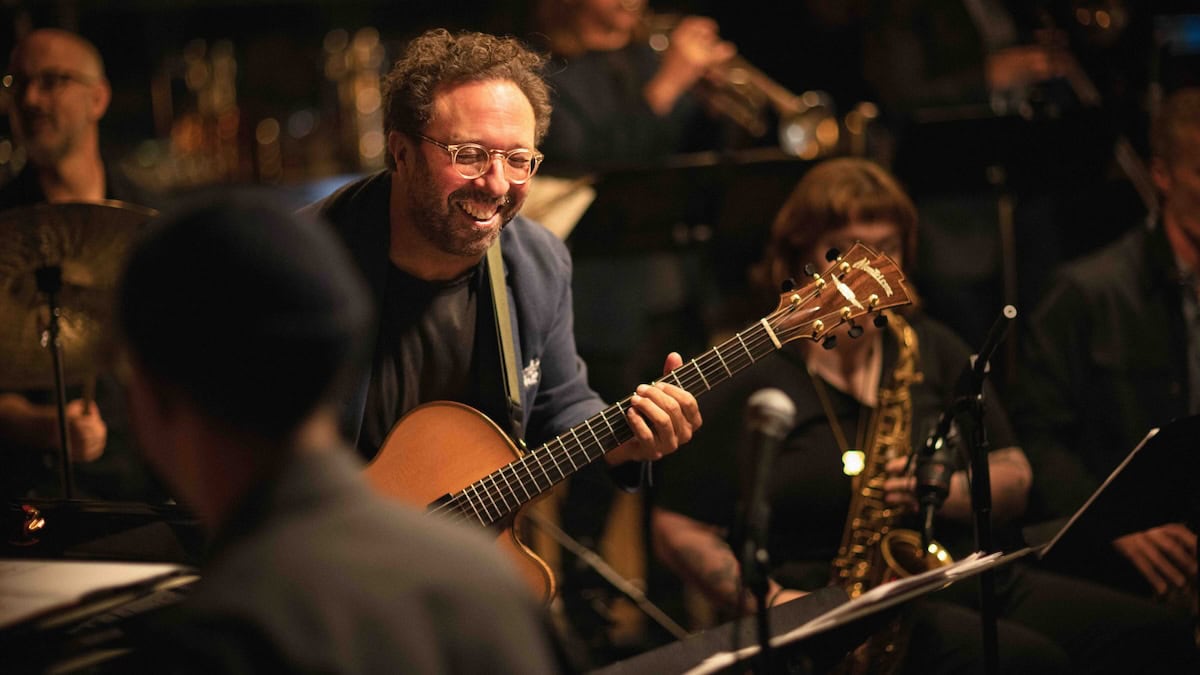
JGT contributor Joe Barth talks to guitarist Anthony Wilson about his new album, “House of the Singing Blossoms”
Anthony Wilson is one of the highest-profile jazz guitarists today. His employer, Diana Krall, is selling out concert halls around the world as well as selling CDs by the truckloads. Anthony was born in Los Angeles on May 9, 1968, and is the son of arranger/bandleader Gerald Wilson.
As a soloist, Anthony’s style is thematic, fluid, and he always makes musical sense. His improvised solos are so logical and satisfying that you would think that he penned them on paper before playing them, without losing a sense of freshness and spontaneity in his playing.
As a composer, he won the prestigious Thelonious Monk International Composers Competition in 1995. In addition to his work with Diana Krall, he has many albums released under his own name. Many groups have commissioned him to compose for them, including the Henry Mancini Institute Orchestra. Anthony and I talk about his newest album, “House of the Singing Blossoms.”
JB: So, before I ask about the new album, you haven’t been featured in Jazz Guitar Today. Briefly tell me about yourself. You were born in Los Angeles and are the son of famed trumpeter and arranger Gerald Wilson. When did you start to play jazz guitar, and in those early years, what was most helpful in your personal development as a guitarist?
AW: That’s right. I was born in Los Angeles, and have lived here most of my life, though I went to college in Vermont, and lived in New York City for five years in the 1990s. My father, Gerald Wilson, as you point out, was a trumpeter and a composer/arranger who led a jazz orchestra pretty much continuously from 1945 to the time of his passing in 2014. He even had gigs on the books when he passed away, and I conducted the orchestra for those performances. My mother, Anita, was not a musician, but was a huge music lover with an incredibly wide range of tastes. You could find everything from Ravi Shankar to Merle Haggard to Bud Powell in her record collection. So, my parents did set the tone for my being exposed, as a young child, to musicians and music of all kinds. And as a child of the 1970s, I would watch things like Soul Train and American Bandstand on TV, and if I was up late, things like Midnight Special. Early on, I learned to play folk and blues songs, and things by artists such as Bob Dylan, The Beatles, Aerosmith, Glen Campbell, and Joni Mitchell. Then, when I was about 13, even though I had heard quite a bit of jazz by then, I suddenly got bit by the jazz bug after hearing some albums that really made an impression on me. One was “Gotham City,” by Dexter Gordon, which featured George Benson, Cedar Walton, Percy Heath, and Art Blakey. George Benson takes a solo on the tune “Hi-Fly” that I still return to for inspiration these days. Another was “Outward Bound” by Eric Dolphy, which actually included a song that was named for my father! I loved the version of “Green Dolphin Street” on that album. At that time, Miles Davis’ ultimate gateway album, “Kind of Blue,” was a life-changer for me. I pretty much decided around that time that I really wanted to learn to play this music. Then my mom put some Wes Montgomery, Kenny Burrell, and Johnny Smith records in my hand, all of which were like portals into another dimension. Those indelible sounds guided me then and still do now.
JB: What are three of the most influential jazz guitar albums to you and your personal development as a guitarist, and why?
AW: There’s no doubt that the first Wes Montgomery trio album on Riverside Records (with Melvin Rhyne and Paul Parker) has been hugely important to me. It has a kind of perfection in the economy of its sound and the repertoire chosen for it. Montgomery had arrived at his beautiful combination of single lines, octaves, and block chords as tools for developing his solos, and each one on that album is a jewel. I learned his solos on “Satin Doll,” “The End of a Love Affair,” “Round Midnight,” and “Missile Blues,” and I still practice them to this day. I thrill at the sound of the guitar on that album, the elegance and soulfulness of Wes’s playing, the contour of his lines, even the rattling, microphonic tube in the amp!
Another album I loved that really made an impression on me was not by a guitarist, but in many ways, for me, it is a true jazz guitar masterpiece. That’s The Paul Desmond Quartet Live, on Horizon Records, featuring Ed Bickert on guitar, as well as Don Thompson on bass and Jerry Fuller on drums. This was in my mom’s collection, and I listened to it throughout my teenage years. I fell in love with Ed Bickert’s sound and improvising and have only come to appreciate him more over the years. He is a marvelous accompanist for Paul Desmond. Every voicing, every phrase he plays is a gem.
Kenny Burrell’s A Night at the Village Vanguard with Roy Haynes and Richard Davis is another one that I come back to repeatedly. From the first vamp in front of the G blues “All Night Long,” it grabs you and doesn’t let go. Every tune is masterful. “I’m a Fool to Want You” gives me goosebumps. This is exciting, self-assured, soulful, elegant jazz guitar playing at its very best. State of the art: then, now, and tomorrow.

JB: You have been with singer Diana Krall for over twenty years. What do you appreciate most about being in her touring combo?
AW: Diana and I have had a great time working together over the years, both on stage and in the studio. I think we both recognized very quickly that there was something we had, as pianist and guitarist, as well as vocalist and accompanist, that just clicked. It’s been rare that we have to talk about some musical issue in order to figure out how to make it work. It seems to me like I can just naturally hear where she’s going with a melody choice or chord change, or with the timing of a phrase, and just fall right into place. And from the beginning of our work together, it’s been clear that she wants me simply to be myself. That kind of affirmation is incredibly freeing for me, and I think it has been one reason why we have worked so well together for such a long time.
JB: On your new album, House of the Singing Blossoms, I love your rendition of your dad’s “Triple Chase”. Discuss the influence your dad has had on your career as a composer and guitarist.
AW: Thanks so much — I love the tune too and really love the performance. It gets the album going right out of the gate in a seriously swinging way!
My father was a very great musician. Let’s get that out of the way first. Long before I was ever born, he had accomplished a great deal as a trumpeter, composer, and arranger. He had played trumpet in and written for the bands of Jimmy Lunceford, Count Basie, and Duke Ellington. He had written arrangements for Ella Fitzgerald, Sarah Vaughan, Billie Holiday, Johnny Hartman, and Nancy Wilson. He was part of a generation that saw the Swing Era at its apex and witnessed the transition to Bebop. And he tracked the progress of Bebop’s innovations as they developed through the 1950s into the modal and “Free” explorations of the 1960s. Long before I was ever born, he had been right in the center of all that. His comportment as a person, his way of talking, his personal style, his integrity — they all reflect having been raised in that deep culture.
So driving in the car with him, just observing the city of Los Angeles as a youngster, was like a lesson. He’d point out a location and casually say something like, “That’s where Billy Berg’s was — the club where Charlie Parker and Dizzy Gillespie played their first engagement in Los Angeles.” Or we’d be listening to the radio, and he’d hear a recording, and he could tell you who was on it and when and where it was recorded. He had bank accounts at the Credit Union that was affiliated with Musicians’ Union, and we’d be there standing in the banking line and he’d chat with the other musicians also waiting to make their deposits or withdrawals, such as saxophonist Teddy Edwards or guitarist John Collins. And as they’d tell stories and laugh, I witnessed that warm sense of fellowship that exists between musicians with shared experience. So, his influence on me, musically speaking, can’t be separated from that cultural foundation that he represented. I think from that example, I gleaned that it was extremely important to love and honor the traditions and benchmarks established by the masters of the music, while also finding a way to make one’s own individual contribution that might keep the sound and the culture moving forward.
Of course, by listening to the specifics of my dad’s music, studying the way he wrote his arrangements, voiced his chords, harmonized ensemble passages, created compelling rhythmic interest or harmonic support in a solo background, or developed a shout chorus, I have had a chance to truly appreciate what made him unique and important within the large community of great composer/arrangers. Because of my proximity to him and the fact that I have made it my business to really know his music at a deep level, he has had a very big influence on me. I try to carry the influence lightly, as a set of steady shoulders that I can stand on, helping me to see new vistas ahead.
JB: You do beautiful solo and ensemble playing on Joe Zawinul’s “In a Silent Way” and the funky “Walk Tall.” What draws you to those two compositions?
AW: I’m happy that on this new album, I took an opportunity to feature some songs by other composers I love, such as my father, Bennie Wallace, the Beatles, Ben Wendel, Keith Jarrett and Joe Zawinul. Zawinul is truly one of my favorites. If he had only written “Mercy, Mercy, Mercy” he’d comfortably be in the pantheon. But he also wrote “Birdland,” “A Remark You Made,” and many more — plus these two incredible songs! As a composer, he just has a way with a musical theme, and there seems to be no end to his ability to come up with “bangers,” as the kids say these days. Throughout every era of his catalog, you will find nothing but really strong songs. Even the meditative theme of “In a Silent Way” has a sense of bloom and life to it that are rare to find. And the uplifting message for people to “Walk Tall” is perfectly expressed in that song’s anthemic melody. Add to that, they are both in the key of E. It just naturally presented a great opportunity for a medley.
JB: The music of the Beatles comes up now and then in your recordings. Why feature “Because” on this recording?
AW: What can I say? A perfect song, with a built-in beginning, middle, and end, and a harmonic structure that I thought would lend itself to this ensemble beautifully. I love playing the hypnotic arpeggiated accompaniment on guitar, and the opportunity to integrate some improvisation into the proceedings after the middle section of the song, without upsetting the delicate balance of the composition itself.
JB: I can’t ask about all the songs on the album. What drew you to the two compositions from Keith Jarrett’s Treasure Island record?
AW: Keith Jarrett is one of my favorite musicians of all time. I am a super Keith Jarrett fanboy. As an improviser, as a composer, as a bandleader, I’m endlessly inspired by what he has done. And his “American Quartet,” with Dewey Redman, Charlie Haden, and Paul Motian (sometimes also incorporating guitarist Sam Brown), really seemed to have a special understanding of what makes his songs so special. I love the looseness that they invite into what can also be very complex and demanding compositions, and then the lyricism that they also cultivate. The connection to the groove is very strong in this band, and those two pieces, “Introduction and Yaqui Indian Folk Song,” and “Le Mistral” kind of embody all those qualities for me. The folk song has a pretty set structure, but “Le Mistral” can be completely different with each performance. I really enjoyed adapting Keith’s solo-piano voicings to the horn choir for “Introduction.”
JB: What special musical satisfaction do you find in working with your Nonet?
AW: The other night I played a solo gig on acoustic guitar. All I had to do was walk out my door with my guitar, drive to the gig, then take out my guitar and sit in front of a microphone and play my set. It really was a joy! So easy, and such a contrast from corralling nine people together, writing all the music, copying the parts, rehearsing, conducting, and cueing during the performance, as well as concentrating on what I have to play, and then packing everything up at the end of a night. Why would I keep putting myself through that?
Well….There’s a magic level that gets unlocked within a large collective. I find it in the way that all these individuals with different voices on their instruments and different approaches to improvisation and ensemble playing can coalesce and create something much greater than the sum of the parts. It’s there in the power of the sound and groove that is possible when the band is really roaring, as well as the softer dynamics that seem heightened when the band really whispers. The unpredictability of the experience is multiplied when you have this many people thrown into the mix, and as the ringleader, I can actually embrace that unpredictability and incorporate it into our performances. When it starts to feel like we’re all witnessing something happening that we had no idea was possible within the given parameters of any particular arrangement, I really love leaning into that.
And then, when I’m playing a solo or melody on the guitar, and the ensemble comes with a written passage that warmly supports what I’m playing? There’s no feeling like that. It’s just amazing. Or when somebody else is soloing and I can craft an environment for that person just by setting up with the horns a spontaneous, improvised texture or riff, that inspires the soloist to go even further? It’s addictive, and probably why I keep coming back to this ensemble.
JB: What do you appreciate most about the Monteleone guitar you play?
At this point, I’ve been playing my Radio Flyer guitar, built by John Monteleone, for over twenty years. It is almost like a part of me. Its tone has mellowed and opened over the years, and it simply sings. It works in many different dynamic contexts and has a beautiful clarity of projection when amplified, that is an extension of the fact that it is, above all else, a great acoustic instrument.
Thank you for reading this post, don't forget to subscribe!


Nexus From Guitarist Jordi Farres

New Vince Lewis Guitar Arrangement, “What The World Needs Now”

Veda & The String Machine’s New Album, Rise And Shine

New Recording From Guitarist Doug MacDonald, Tribute To South Central

Joe Negri Dies Just 10 Days before His 100th Birthday

Jazz Guitar Today Lesson: Variations On Standard Jazz Blues Chord Changes – Part 2

Guitar Great Ron Eschete’ Dies at age 77

One of Chile’s Finest Fingerstyle Guitarists, German Herlein
Jazz Guitar Today Lesson: Variations On Standard Jazz Blues Chord Changes – Part 2
Jazz Guitar Today Lesson: Variations On Standard Jazz Blues Chord Changes – Part 1
Jazz Guitar Today Lesson: “Pensative”
Jazz Guitar Today Lesson: “Central Park West”
New Vince Lewis Guitar Arrangement, “What The World Needs Now”
New Vince Lewis Guitar Arrangement, “Anything Goes”

Saying Goodbye To An Atlanta Jazz Musician, Sal Gentile

Jazz Guitarist Eleonora Strino Talks To JGT
-

 Jazz Guitar Lessons8 hours ago
Jazz Guitar Today Lesson: Variations On Standard Jazz Blues Chord Changes – Part 2
-
Jazz Guitar Lessons2 weeks ago
Jazz Guitar Today Lesson: Variations On Standard Jazz Blues Chord Changes – Part 1
-
 Jazz Guitar Lessons5 hours ago
New Vince Lewis Guitar Arrangement, “What The World Needs Now”
-
Artist News2 weeks ago
Guitar Great Ron Eschete’ Dies at age 77

