
Artist Features
Alex Goodman Talks to Jazz Guitar Today

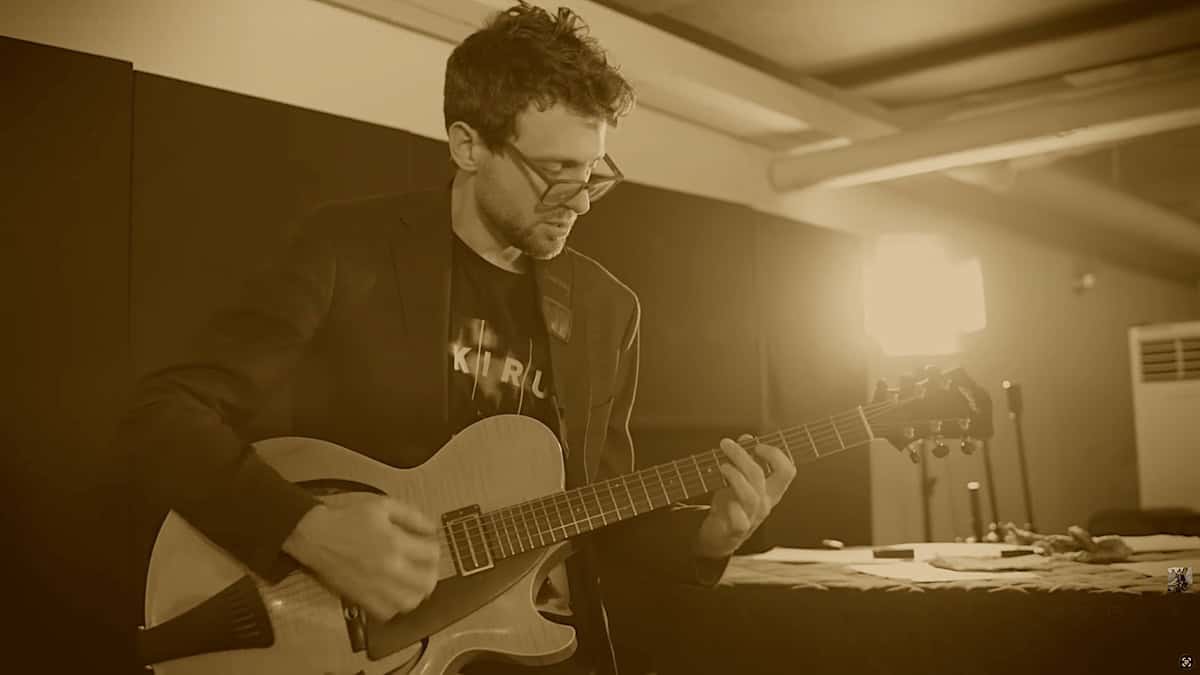
JGT’s Joe Barth talks to guitarist Alex Goodman.
Growing up in Toronto, Alex Goodman moved to New York City in 2012. Jazz Times magazine has called him “among the most promising talents of (his) generation.” Jazziz went on to refer to Alex as “one of New York’s most vital young guitarists.” I talked with Alex to ask about his approach to the guitar.
JB: Growing up in Toronto, talk about when you started to play guitar and what inspired you to play jazz guitar.
AG: I started playing guitar at 14. I had studied piano as a child but stopped when I was about 12. In high school, I saw a poster for a jazz camp in Ontario, where I’m from, that sparked my curiosity. I was playing in a rock band at the time and becoming more drawn to improvisation, so jazz felt like a natural next step. Around that time, I had also discovered Wes Montgomery and hearing him was a revelation. That camp set everything in motion, and I began studying with Rob Campbell at the Eli Kassner Academy in Toronto. From there, my interest deepened and gradually turned into a real commitment to jazz.
JB: Who did you study jazz guitar with in Toronto, and what did you appreciate about that era of your life?
AG: My instructor at that jazz camp was Lorne Lofsky, who had played with Oscar Peterson and alongside Ed Bickert for many years. We actually played a duo concert together in Toronto this month, which felt meaningful. I later completed a degree in Jazz Performance at the University of Toronto, studying privately with Geoff Young, David Occhipinti, and Tim Ries. I was also fortunate to hear guitarist Reg Schwager, who regularly influenced me. Toronto has a strong lineage of jazz guitarists; Ed Bickert lived there, and his presence was always felt. I am grateful to have come up in that serious but generous environment.
JB: Your graduate experiences were at the Manhattan School of Music. Did you study with Rodney Jones and/or Jack Wilkins, and what did you appreciate about that era of your development?
AG: I studied with Rodney Jones at MSM, which was formative. He situated jazz guitar within a broader musical tradition and shared perspectives I had not yet developed. I also worked with a wide range of teachers, including Jim McNeely, Phil Markowitz, Chris Rosenberg, John Riley, and J. Mark Stambaugh in classical composition. Chris Rosenberg encouraged me to write a book of contrapuntal guitar etudes, inspired in part by Jimmy Wyble. I recorded and published it at the end of my studies. I am grateful for this learning, and for the push I received from a teacher toward an ambitious, self-directed project. In a way, it has come full circle. I am now guiding a talented student at the Kunst Universität Graz through developing his own book of contrapuntal guitar pieces.
JB: To you, in shaping your sound and approach, what were some of the most influential jazz guitar albums and why?
AG: I have to begin with The Incredible Jazz Guitar of Wes Montgomery. I had never heard anything like it. His feel, phrasing, and unmistakable voice drew me fully into jazz, and that record still resonates with me.
As a Canadian, I would also mention Paul Desmond’s album Pure Desmond with Ed Bickert, Ron Carter, and Connie Kay. Ed remains a hero of mine. His subtlety, warmth, and harmonic depth were extraordinary. I also love Jim Hall’s many recordings with Paul Desmond. There is so much clarity, heart, and restraint on those records.
At one point, I tried to find every Ed Bickert recording I could. The Ballad Artistry of Buddy Tate, At the Garden Party, Thinking of You with Frank Rosolino, and With a Song in My Heart with Jane Hall are some of my favorites. Those albums taught me about harmony, economy, and patience.
Bill Frisell’s Solos: The Jazz Sessions is another important one for me. It sustained me during difficult periods and revealed the emotional expansiveness of solo guitar. I also love hearing Bill talk about music on the album.
JB: What have you found most rewarding and challenging about blending classical (Bartok and Chopin) and jazz, as you did on your Bridges album?
AG: I have always approached composition seriously and studied it alongside the guitar. When I interpret Bartok or Chopin, it comes from deep respect and careful listening. The challenge is preserving the structure and intention of the original while creating space for improvisation. On Bridges, I was coming out of an intensive period of classical study and wanted to internalize and interpret the music that had shaped me.
More recently, I have been writing for string quartet, guitar, and bass, and studying composers from the Renaissance to the present. It has become less about direct interpretation and more about absorbing their thinking and letting it naturally shape my own writing.
JB: Tell me about two of your most memorable performance or recording experiences.
AG: I’ll start with something very recent. This month I played at Mezzrow in New York with Ben Street and Adam Arruda, and the following night with Ben and Eric McPherson. I’ve been playing with Adam since we were teenagers in Toronto, so there’s deep trust and shared history with him. Sharing the stage with Ben — whose work we had long admired alongside guitarists like Bill Frisell, John Scofield, and Kurt Rosenwinkel — felt like a creative push. There’s something special about admiring a player’s work from afar and then having the opportunity to make music with them. It’s equally meaningful to have grown alongside a close friend like Adam over so many years and to share experiences like that.
A formative chapter for me in New York was performing at Smalls Jazz Club with Lucas Pino’s group. It was a close-knit community of peers, including Glenn Zaleski, Jimmy Macbride, Desmond White, Colin Stranahan, Alex LoRe, Nick Finzer, Rick Rosato, and fellow guitarists Alex Wintz and Rafal Sarnecki. We played and developed together in a range of contexts, both personally and professionally. Performing consistently for an attentive audience at a club like Smalls gave me invaluable experience and helped shape my growth. One of my main musical goals has always been to grow within a community of great musicians, and during Lucas’s residency, that’s what it felt like we were doing.
JB: Is your newest album Impressions in Blue and Red, and if so, tell us about it?
AG: I’ve released several albums since Impressions in Blue and Red. More recently, I began a trio series: Good Morning Heartache with Martin Nevin and Adam Arruda; Trio, After All with Rick Rosato and Mark Ferber; and Home Ground, recorded in Toronto with Adam Arruda and Neil Swainson, with several pieces featuring Reg Schwager, coming this summer.
Most were informal half-day sessions engineered by my longtime friend and excellent musician Matt Marantz, documenting the music among close collaborators. We recorded my compositions alongside music by eclectic artists such as the Beach Boys, J.S. Bach, Antonio Carlos Jobim, and Brahms. These albums capture the spontaneity I value in jazz and stand in contrast to the more structured string works I’m preparing to release next — projects I’ve been developing for many years.
JB: What do you appreciate most about the guitars that you use?
AG: I have played Collings guitars for about 13 years. They are exceptionally balanced instruments with a wide dynamic range. I use a heavier setup, 16 to 60 gauge strings with acoustic-style action, and my Collings Eastside LC handles the tension while remaining resonant and clear. I have installed an internal microphone to better capture its acoustic character. Visiting the factory in Austin and seeing the care that goes into their process deepened my appreciation for the instrument and the work they do.
JB: Talk about your teaching in Austria.
AG: In 2024, I began teaching at the Kunst Universität Graz, the oldest jazz program in Europe. I teach all undergraduate and postgraduate guitar students. It is a competitive environment, and the students are deeply committed. I try to focus on musicianship, feel, sound, and the intangibles in music as well as technique. With world-class artists regularly visiting, it is a vibrant place for growth. I am really honored to be part of it.
JB: New York is home to scores of good guitarists. You have been there for several years. What is the best piece of advice you would give younger guitarists for building a career in music?
AG: The landscape shifts constantly, and it does not become easier. I respect anyone who chooses this path. For me, sustained curiosity and genuine love for the music are essential. A passion-driven study goes deeper than competition. Trust the process, do the work seriously, and stay honest about what truly moves you. That honesty can help guide an authentic musical practice.
Thank you for reading this post, don't forget to subscribe!


New Album From Tom Lippincott, Ode To The Possible

Colombian Jazz Guitarist Daniel Pinilla

Jazz Guitar Today Pays Tribute To Guitarist Joe Negri

Video Podcast With Giuseppe Continenza
Italian Guitar Master, Giuseppe Continenza

Nexus From Guitarist Jordi Farres

New Vince Lewis Guitar Arrangement, “What The World Needs Now”

Veda & The String Machine’s New Album, Rise And Shine

Jazz Guitar Today Lesson: Variations On Standard Jazz Blues Chord Changes – Part 2
Jazz Guitar Today Lesson: Variations On Standard Jazz Blues Chord Changes – Part 1
Jazz Guitar Today Lesson: “Pensative”
New Vince Lewis Guitar Arrangement, “What The World Needs Now”
New Vince Lewis Guitar Arrangement, “Anything Goes”

Saying Goodbye To An Atlanta Jazz Musician, Sal Gentile

Guitar Great Ron Eschete’ Dies at age 77

British Smooth-Jazz Guitar Master, Chris Standring
-

 Jazz Guitar Lessons1 week ago
Jazz Guitar Today Lesson: Variations On Standard Jazz Blues Chord Changes – Part 2
-
Jazz Guitar Lessons3 weeks ago
Jazz Guitar Today Lesson: Variations On Standard Jazz Blues Chord Changes – Part 1
-
 Jazz Guitar Lessons1 week ago
New Vince Lewis Guitar Arrangement, “What The World Needs Now”
-
Artist News3 weeks ago
Guitar Great Ron Eschete’ Dies at age 77

