
Artist Features
Guitarist Greg Ruggiero Talks To Jazz Guitar Today

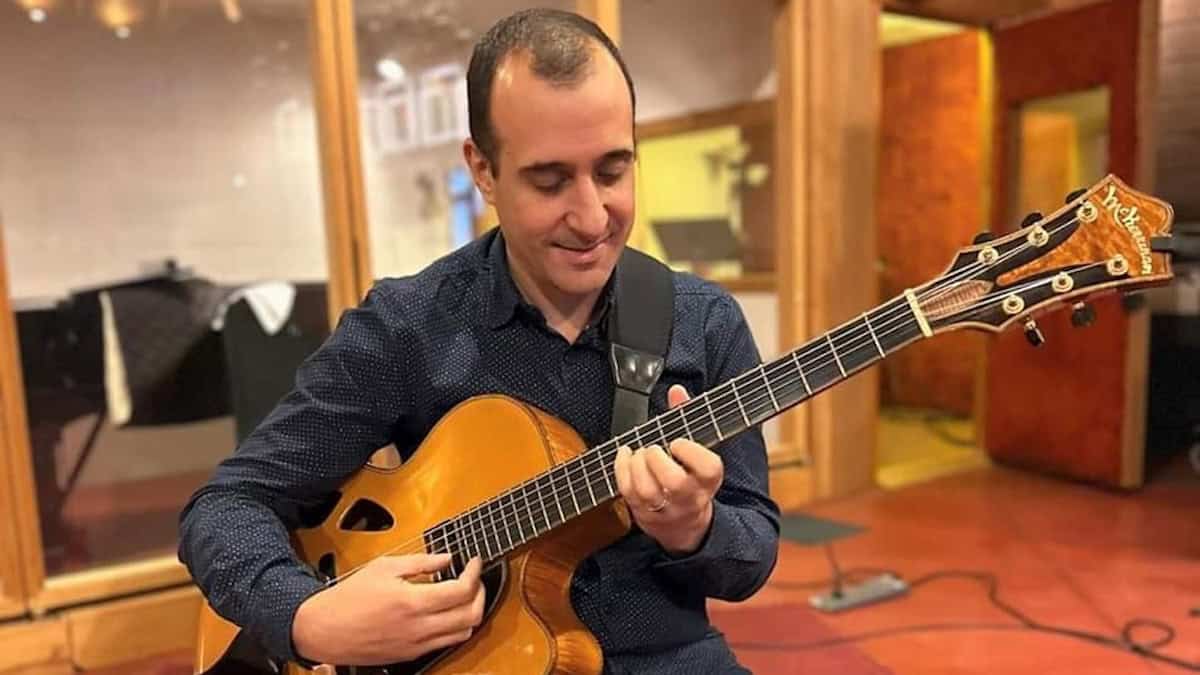
JGT contributor Joe Barth chats with jazz guitarist Greg Ruggiero about his approach to the guitar and musical career.
On any given night in New York City, Greg Ruggiero can be seen playing jazz guitar. Greg has been on the New York scene since 2004. Originally from New Mexico, Greg is comfortable performing in all aspects of the jazz style. I chatted with Greg about his approach to the guitar and musical career.
JB: Where did you grow up, and what inspired you to play jazz guitar?
GR: I grew up in Albuquerque, New Mexico. My grandfather used to fiddle around on various instruments. I remember him singing Standards and Italian songs, accompanying himself at parties. He would have a crowd of people around him who absolutely adored him. I believe he was my earliest inspiration.
JB: Did you study music in college, and if so, what did you appreciate most about that era of your development?
GR: I attended the University of New Mexico for 3 years, but never finished. I really appreciated having players around me who were much better than I and more knowledgeable. I worked hard so I could play with them and learn from them.
JB: To you, in shaping your sound and approach, what are three of the most influential jazz guitar albums and why?
GR: Wes Montgomery – The Incredible Jazz Guitar of Wes Montgomery. Wes inspired me to become a thumb player, even though now I’ve found my own way to use the thumb nail like a pick. I can’t say anything about him that hasn’t been said a million times. His touch and feel, the way he builds his solos, his connection to his ear, his beat, and use of space are all just a master class. Also, that record in particular has such a great group vibe and sound. Tommy Flanagan is impeccable and so melodic as a pianist. The rhythm section of Tootie and Percy Heath brings an incredible groove and energy to the record.
Jim Hall on Sonny Rollins’ The Bridge. Again, the record has an amazing group sound and really highlights Jim Hall’s incredible accompaniment. Jim plays amazing melodic 2 and 3-voice counterpoint. It’s really a lesson on how to comp. His solos are so singable and have some of the most beautiful phrasing you will ever hear.
Third, I would say any recordings of the Nat Cole trio with Oscar Moore. Oscar was so innovative and really changed the role of the guitar in a small group. He was able to go in and out of chunking 4 to comping sparser and more pianistic. He and Nat played so well off each other, like a mini orchestra. He also really utilized all the great things that make the guitar special, like bending notes, sliding, and strumming. Sometimes those elements are lost in jazz guitarists.
JB: Talk about your experiences of performing with pianist Michael Kanan.
GR: Mike is my musical brother and best friend. We talk every day about music. He really guided me when I was looking for the real feeling of swing. He set up countless sessions with older musicians so I could experience the feel firsthand. I’ve been in his trio for 13 years, and I’m so proud of the music we make together. We are very like-minded and continually inspire each other. It’s the kind of musical symbiosis I’ve always wished for. We are always having a conversation musically and are both committed to melody.
JB: What do you find most rewarding and challenging about working in a trio with bass and drums?
GR: Because I’m a side man so often, I find melodies so difficult to get right. There’s always a new tune or song I haven’t played in a while. Playing in a guitar trio means I’m mostly covering the melodies and calling the tunes. I always try to keep it fresh by expanding the repertoire and also making up spontaneous arrangements. I don’t like to plan things out. I like to just start and make it up as we go. To me, that’s the real thing, no plan. I love playing in a trio where all of us are open to wherever the music takes us. No planned intros or endings, just listening and enjoying the rhythm.
JB: Tell us about your third CD, an album of Standards.
GR: It’s About Time was recorded with my trio for many years. It features two legendary New York musicians. Steve Little on drums, who’s best known for playing with Ellington and everybody else as the house drummer on Sesame Street, and Murray Wall, who played with Benny Goodman, “Sweets” Edison, Barry Harris, and countless others. I’m so happy I recorded that trio, because Murray passed away a couple of years ago. I think about him every day. These two exemplify what feels is, and I learned so much by playing with them. The recording was super casual; we just called tunes on the spot and played like we always did.
JB: Tell me about two of your most memorable performance or recording experiences.
GR: I think my most memorable gig is always the gig I just played. I just enjoy the relationships I’ve made, and I’m always looking forward to the next gig. All of the gigs with Mike Kanan’s Trio are special to me. Also, my friend, vocalist Lucy Yeghiazaryan, and I have traveled together. She has taken me to Singapore, and a month earlier, we went to Jakarta to play the Java Jazz Festival. We were literally there for one day and spent two days traveling to get there. That was a wild, whirlwind trip I will never forget.
JB: What do you appreciate most about the guitar that you use?
GR: I embarrassingly have so many guitars at this point, that they are on constant rotation. I used to only use my handmade Mkkerihan archtop. I used to feel like I couldn’t get my sound without it. Now I feel like I can play any guitar and enjoy it. I try to play what each guitar gives me and be open to it the same way I’m open to what different musicians give me. Every relationship is special and can take you to unexpected places.
JB: New York is a town with hundreds of good guitarists. You’ve been there since 2004, so what’s the best piece of advice you’d give younger guitarists for building a career in music?
GR: First and foremost, can you keep going through all of life’s curveballs? It’s one thing to be young and enthusiastic and willing to scuffle, but if and when you get married and have children you are now asking them to go through it with you. That’s not easy, and I totally understand leaving town because it’s so hard to raise a family in New York City. You have to love the scene so much and stay insatiably hungry for the music. I don’t think many people have that kind of tenacity. Musically speaking, for me it’s important to always try to connect with the people you’re playing with, even if they are not looking for that connection. Play good time, with a nice sound, and listen. Probably the most basic advice is show up to gigs on time, dress professionally, and return people’s messages quickly, and also say thank you every time someone offers you a gig. You would be surprised how difficult these simple things are for many musicians.
Thank you for reading this post, don't forget to subscribe!


New Album From Tom Lippincott, Ode To The Possible

Colombian Jazz Guitarist Daniel Pinilla

Jazz Guitar Today Pays Tribute To Guitarist Joe Negri

Video Podcast With Giuseppe Continenza
Italian Guitar Master, Giuseppe Continenza

Nexus From Guitarist Jordi Farres

New Vince Lewis Guitar Arrangement, “What The World Needs Now”

Veda & The String Machine’s New Album, Rise And Shine

Jazz Guitar Today Lesson: Variations On Standard Jazz Blues Chord Changes – Part 2
Jazz Guitar Today Lesson: Variations On Standard Jazz Blues Chord Changes – Part 1
Jazz Guitar Today Lesson: “Pensative”
New Vince Lewis Guitar Arrangement, “What The World Needs Now”
New Vince Lewis Guitar Arrangement, “Anything Goes”

Saying Goodbye To An Atlanta Jazz Musician, Sal Gentile

Guitar Great Ron Eschete’ Dies at age 77

British Smooth-Jazz Guitar Master, Chris Standring
-

 Jazz Guitar Lessons1 week ago
Jazz Guitar Today Lesson: Variations On Standard Jazz Blues Chord Changes – Part 2
-
Jazz Guitar Lessons4 weeks ago
Jazz Guitar Today Lesson: Variations On Standard Jazz Blues Chord Changes – Part 1
-
Jazz Guitar Lessons1 week ago
New Vince Lewis Guitar Arrangement, “What The World Needs Now”
-
Artist News3 weeks ago
Guitar Great Ron Eschete’ Dies at age 77


