
Artist Features
Brazilian Guitarist Lari Basilio Releases, Redemption

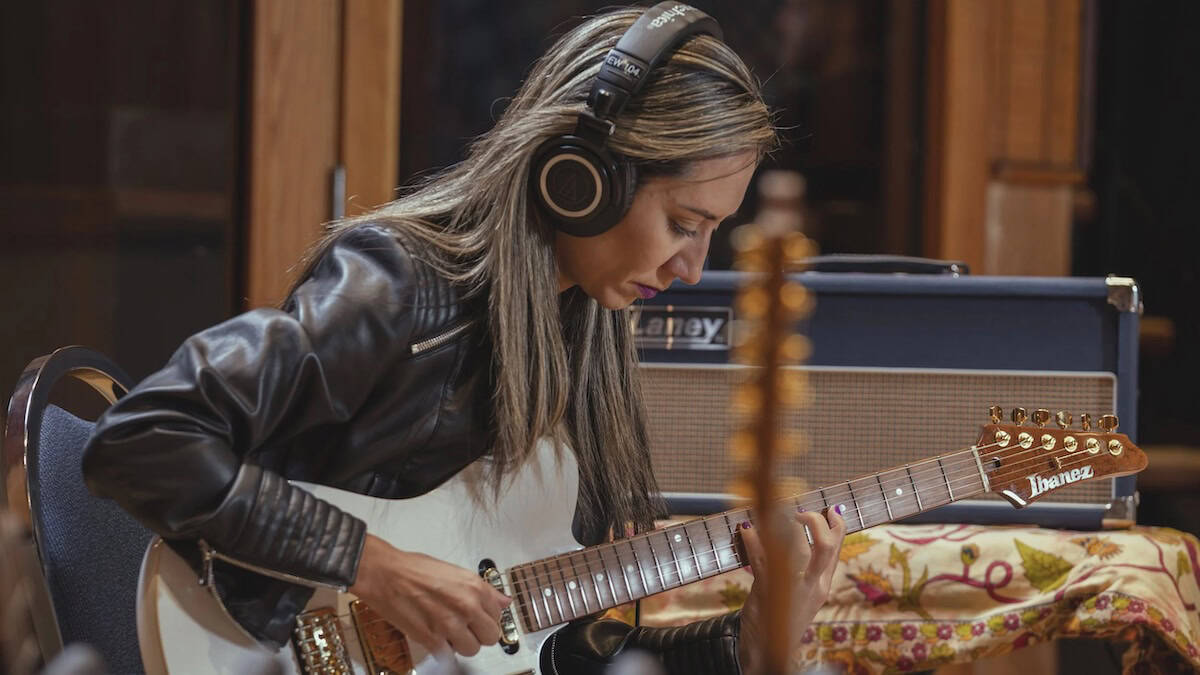
JGT contributor Joe Barth talks to Brazilian guitarist Lari Basilio about her new album, Redemption.
Photo by Eduardo Orelha (May 30th, 2024)
Lari Basilio is a wonderful composer and guitarist from Brazil. Born in São Paulo in 1988, she began playing organ before switching to the guitar. As a young person, she cut her “musical teeth” playing weekly in her church’s worship team. In college, she studied law and became a practicing lawyer, but now devotes her full time to music. In 2019, Joe Satriani invited her to perform at his G4 Experience. She now makes Los Angeles her home. Lari and I talked about her approach to the instrument and her new record, Redemption.

JB: Before I ask about the new album, Redemption, you haven’t been featured in Jazz Guitar Today. Briefly tell me about yourself. You were born and raised in São Paulo, Brazil, where your father exposed you to a lot of music. When did you start to play guitar, and in those early years, what was most helpful in your personal development as a guitarist?
LB: My dad was definitely very important in my learning to play the guitar and music. When he taught me my first chords on an acoustic guitar, that’s all I knew at the time. I wanted to play different songs, but with only those few chords, I would listen to my favorite songs and try to play them by ear. I’m sure this helped me a lot to develop my musicality.
JB: To you personally, what are three of the most influential jazz and/or rock guitar albums that shaped your personal development as a guitarist, and why?
LB: I could mention more than three, but here are some of my favorites: John Mayer – Battle Studies, Joe Satriani – Flying in a Blue Dream, and Andy Timmons – That Was Then, This is Now. These albums are amazing in terms of songwriting, melodies, and guitar tones. Of course, these are artists in their own world with their own characteristics, but these are definitely things that I love about them and have influenced me a lot.
JB: You studied law in college; were you also working on your music at that time?
LB: Yes, it was definitely a challenging time, as law school would take up a lot of my time, but any free time I had, I’d try to make the most of it. Also, music was a way to relax and put my mind in a different place, so I would always make time to play it.
JB: On your new album, Redemption, talk about the track “The Way Home” that opens the album.
LB: I love writing new riffs, and “The Way Home” has one of my favorite riffs to play. It’s upbeat and has always given me a good feeling, and I was on a road coming back home. When I finished writing this song, I knew it would be the opening track of the album.
JB: The album consists entirely of your original songs. Did you compose this music for this particular project?
LB: Yes, I wrote, arranged, and produced all the songs on my latest album, Redemption, as well as on my previous albums. Writing tunes is one of my favorite things to do. I love sitting down to start working on an idea, not knowing how it’s going to end. It’s a very surprising and captivating process. I love it!
JB: You are an excellent tunesmith. Talk briefly about how you go through the compositional process.
LB: Thank you! Each song happens differently. Most of the time, the ideas come from improvising on the guitar, but sometimes I simply have an idea in my head and try to translate it into guitar. At other times, I get ideas while playing the keyboard. It really varies, and I think it’s important to keep it free of formats. The freedom and letting the process of creation flow is so important to me as an artist.
JB: What do you appreciate most about your rhythm section on the album, bassists Sean Hurley and Leland Sklar, and drummer Vinnie Colaiuta?
LB: These guys are legends! Besides, they are amazing people. I love their musicianship and how they work and play to serve the music, with so much class! Each one with their own musical personality has elevated my music so much, and I feel so honored to have worked alongside them!
JB: Talk about the musical relationship you have with keyboardist Mari Jacintho.
LB: Mari Jacintho has been my friend for over ten years. We’ve played together on many projects in Brazil, and it’s always been a joy to play with her! I was fortunate enough to have her play in my album Redemption. She’s a brilliant player!
JB: Tell us about the song “Forever,” which closes the album.
LB: The whole journey of the album Redemption coincides with my motherhood journey. I’m now mom to an amazing boy, and this song “Forever” is pretty much about the family relationship that lasts forever.
JB: You also had an impressive band on your third album, Far More, again with drummer Vinnie Colaiuta, but then bassist Nathan East, and keyboardist Greg Phillinganes.
LB: Yes, the album Far More was also very special. It was fantastic to share musical moments with Vinnie, Nathan, and Greg. There is so much to learn from them, and I certainly took advantage of these moments together in the studio. They are all geniuses, and we can hear the love for music in everything they play!
JB: What special musical satisfaction do you find in working with your touring band?
LB: When we’re on stage, I want to make sure we are all enjoying ourselves, enjoying the music we’re playing, and having fun. Truly, the stage is a really special place to be, and if you’re not feeling it, there’s something wrong.
JB: What do you appreciate most about the Ibanez LB1-BK guitar you play?
LB: I love everything about my signature guitar, the Ibanez LB1. Since the first time I played it, I felt completely at home. It’s very versatile tone-wise.
It’s loaded with my signature Seymour Duncan pickups, and I can access nine different tones with this guitar. Another favorite feature is the compound fretboard radius, which makes it very comfortable to play.
JB: What do you appreciate most from the time you played on church worship teams?
LB: I have always loved playing at church. It’s always a time of spiritual edification, communion, and learning. Musically, I learned so much from other musicians there and grew so much during those years.
JB: We don’t have the Smooth Jazz radio stations like we used to. What are some of your greatest challenges in getting your music “out there?”
LB: This has definitely changed in terms of how we get our music out there. As an independent artist, I learned from the beginning that an online presence would be very important for spreading the word about my work and music, and that’s what I did. With every release, since day one of my original instrumental career, I have made sure to have enough material online, in good quality, audio and video, so we can maximize reach and grow the audience.
Thank you for reading this post, don't forget to subscribe!


Nexus From Guitarist Jordi Farres

New Vince Lewis Guitar Arrangement, “What The World Needs Now”

Veda & The String Machine’s New Album, Rise And Shine

New Recording From Guitarist Doug MacDonald, Tribute To South Central

Joe Negri Dies Just 10 Days before His 100th Birthday

Jazz Guitar Today Lesson: Variations On Standard Jazz Blues Chord Changes – Part 2

Guitar Great Ron Eschete’ Dies at age 77

One of Chile’s Finest Fingerstyle Guitarists, German Herlein
Jazz Guitar Today Lesson: Variations On Standard Jazz Blues Chord Changes – Part 2
Jazz Guitar Today Lesson: Variations On Standard Jazz Blues Chord Changes – Part 1
Jazz Guitar Today Lesson: “Pensative”
Jazz Guitar Today Lesson: “Central Park West”
New Vince Lewis Guitar Arrangement, “What The World Needs Now”
New Vince Lewis Guitar Arrangement, “Anything Goes”

Saying Goodbye To An Atlanta Jazz Musician, Sal Gentile

Jazz Guitarist Eleonora Strino Talks To JGT
-

 Jazz Guitar Lessons2 days ago
Jazz Guitar Today Lesson: Variations On Standard Jazz Blues Chord Changes – Part 2
-
Jazz Guitar Lessons2 weeks ago
Jazz Guitar Today Lesson: Variations On Standard Jazz Blues Chord Changes – Part 1
-
 Jazz Guitar Lessons2 days ago
New Vince Lewis Guitar Arrangement, “What The World Needs Now”
-
Artist News2 weeks ago
Guitar Great Ron Eschete’ Dies at age 77

