
Artist Features
Greek Bouzouki Virtuoso and Jazz Guitarist, Michael Paouris

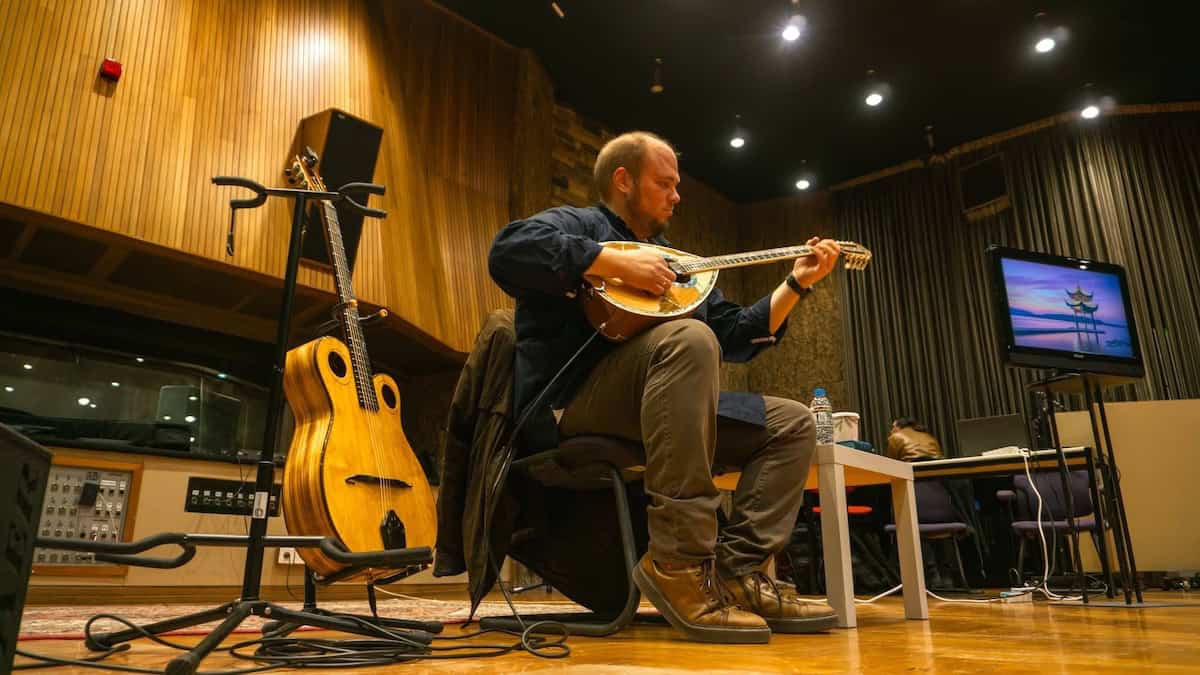
JGT contributor Joe Barth talks to Michael Paouris about his approach to jazz guitar.
Michael Paouris is a virtuoso bouzouki (Greek guitar/mandolin-like instrument) and jazz guitarist. Living in Greece, he is not well known here in the United States, but he deserves to be better known.
JB: Growing up in Greece, you started on the mandolin-like Bouzouki. What inspired you to play jazz Guitar?
MP: I grew up in Tavros, Athens, surrounded by Greek popular music. The period from the 1950s to the 1970s was a golden cultural era in Greece, and although I was born in 1987, I absorbed it deeply through composers like Mikis Theodorakis and Manos Hadjidakis.
I asked my parents for a Bouzouki — a four-course, double-stringed instrument tuned like a Guitar one tone lower (D–A–F–C). My love for the Guitar came at fifteen, when I randomly picked one up at school and immediately felt at home. From then on, I explored its musical worlds. By age nine, I was already playing sixteenth notes at 280 BPM, which made everything feel technically natural.
JB: Did you study music in college, and if so, what did you appreciate about that era of your development?
MP: I completed only the first three levels of music theory. The conservatory system felt too slow for the way my mind worked, so I left at ten. That same year, I began performing professionally in venues where the Bouzouki dominated.
Driven by the polyphony I felt internally and the technique that came easily to me, I taught myself to read and write music at fifteen. From there, I began composing everything from jazz fusion to symphonic works. To date, I have released 50 albums and composed more than 2,500 classical and jazz works.
JB: Wow! You are very passionate about playing the Bouzouki. What do you appreciate most about using that instrument as your musical voice?
MP: The Bouzouki has a uniquely direct and immediate sound — it speaks without hesitation or softness in between. That intensity has always moved me.
Unlike many instruments, its authentic sound has never been successfully replicated in sound libraries, largely because of the depth and intensity of its playing technique. I always wanted that voice to exist in other musical worlds, and I became the first to formally integrate the Bouzouki into jazz and present it in an innovative way within classical music.
JB: To you, in shaping your sound and approach as a jazz guitarist, what are three of the most influential jazz guitar albums and why?
John McLaughlin, Paco de Lucía, and Al Di Meola: Friday Night in San Francisco was the first album on which I imagined myself inside the music. As a teenager, I played along to every detail without scores — it felt completely natural.
Chick Corea Elektric Band’s Beneath the Mask gave me the sense of freedom that led me directly into fusion. Chick Corea’s “Spain” also resonated deeply because its scales felt very close to Greek musical language.
Finally, Oscar Peterson’s Canadian Suite reflected the speed and energy I already felt internally — and pushed me even further.
More broadly, I believe the best musical results come from what I call the “extra-musical”: broad education, intellectual alertness, and constant mental development. Technique becomes the bridge that allows true stylistic freedom.
JB: You first worked with guitarist Al Di Meola when you were just twenty-four, and then you toured with him again in 2024. What do you find most rewarding and challenging about performing with Al?
MP: I am deeply grateful to Al Di Meola. He supported me from the beginning without trying to change me, standing beside me almost like a musical father. That human connection means more to me than anything else.
Musically, the greatest challenge is his rhythmic universe — highly syncopated, geometric, and non-linear. When you truly understand it, you discover the spaces where magic happens. The first time we played together, he said, “I want our feet to move the same way.” We locked into the rhythm physically, and without rehearsal, our musical connection was complete.
JB: Tell us about the jazz guitar album you did in 2013.
MP: Sonically, the album was not my best work because I lacked studio experience at the time. But artistic evolution is evident when compared with later albums like Alternate Picking (2020) and Suite for 5 Guitars.
Still, The Virtuoso Project (2013) contains major musical statements, especially for the acoustic guitar with a pick. My piece “Django’s Rainy Heart” introduced extremely demanding techniques that had not been presented before and drew significant attention.
JB: Tell me about two of your most memorable performance or recording experiences.
MP: One defining moment was receiving the First World Prize at the Mozart House in Vienna, performing “Virtuosonata No.1,” written just twelve days earlier. Audience members told me, “Mozart returned home.” I replied, “My name is Michael Paouris, and I am from Tavros, Athens.”
Another was performing at the Damascus Opera House during a semi-war period. I was honored by the Syrian University of Arts and dedicated my composition, “Damascus,” to the people of the city. The concert was broadcast live on national television.
And a humorous moment — after my performance at DROM in New York, the club owner asked the sound engineer if I was playing playback.
JB: What do you appreciate most about what looks like an Ibanez archtop guitar you use?
MP: I love its sound, even though it is one of the most demanding guitars to play. It is the instrument on which I performed “Paourissimo,” considered one of the most difficult acoustic guitar pieces ever written for pick technique. I love acoustic instruments, especially when they challenge me.
JB: Talk about your current career and what musical things you are doing today.
MP: In December 2025, I was honored by the Academy of Athens for my artistic contribution, international recognition, and compositional innovation — the first time the Bouzouki and the Acoustic Guitar have been recognized by the institution. It was a deeply moving moment.
My autobiographical and philosophical book The Capital First Letter was also released, exploring the idea of striving to embody our roles with excellence worthy of a capital letter.
In January 2026, my 50th album, Sobre el Puente del Mañana, a Latin Jazz Fusion project, was released featuring Billy Sheehan, Gergo Borlai, Gumbi Ortiz, Edgar Abraham, Sandy Gabriel, and Richard Szaniszlo. The mixing and mastering were done by Boris Milan. It is a highly demanding Guitar album in which I also perform on the Bouzouki. I am currently preparing the symphonic orchestrations of this work for performances with a symphony orchestra in Greece and internationally.
Thank you for reading this post, don't forget to subscribe!


Gypsy Jazz Master Stephane Wrembel

Creating the Right Emotional Temperature for the Room

New Album From Tom Lippincott, Ode To The Possible

Colombian Jazz Guitarist Daniel Pinilla

Jazz Guitar Today Pays Tribute To Guitarist Joe Negri

Video Podcast With Giuseppe Continenza
Italian Guitar Master, Giuseppe Continenza

Nexus From Guitarist Jordi Farres

Jazz Guitar Today Lesson: Variations On Standard Jazz Blues Chord Changes – Part 2
Jazz Guitar Today Lesson: Variations On Standard Jazz Blues Chord Changes – Part 1
Jazz Guitar Today Lesson: “Pensative”

New Vince Lewis Guitar Arrangement, “What The World Needs Now”
New Vince Lewis Guitar Arrangement, “Anything Goes”

Guitar Great Ron Eschete’ Dies at age 77

British Smooth-Jazz Guitar Master, Chris Standring

Jack West, Bay Area Explorer of New Guitar Sounds
-
 Jazz Guitar Lessons2 weeks ago
Jazz Guitar Today Lesson: Variations On Standard Jazz Blues Chord Changes – Part 2
-
 Jazz Guitar Lessons2 weeks ago
New Vince Lewis Guitar Arrangement, “What The World Needs Now”
-
 Artist News4 weeks ago
Guitar Great Ron Eschete’ Dies at age 77
-
Artist Features2 weeks ago
Italian Guitar Master, Giuseppe Continenza