
Artist Features
Guitarist Jonathan Goldberger Divides His Musical Endeavors Between Jazz Guitar And Film Composition

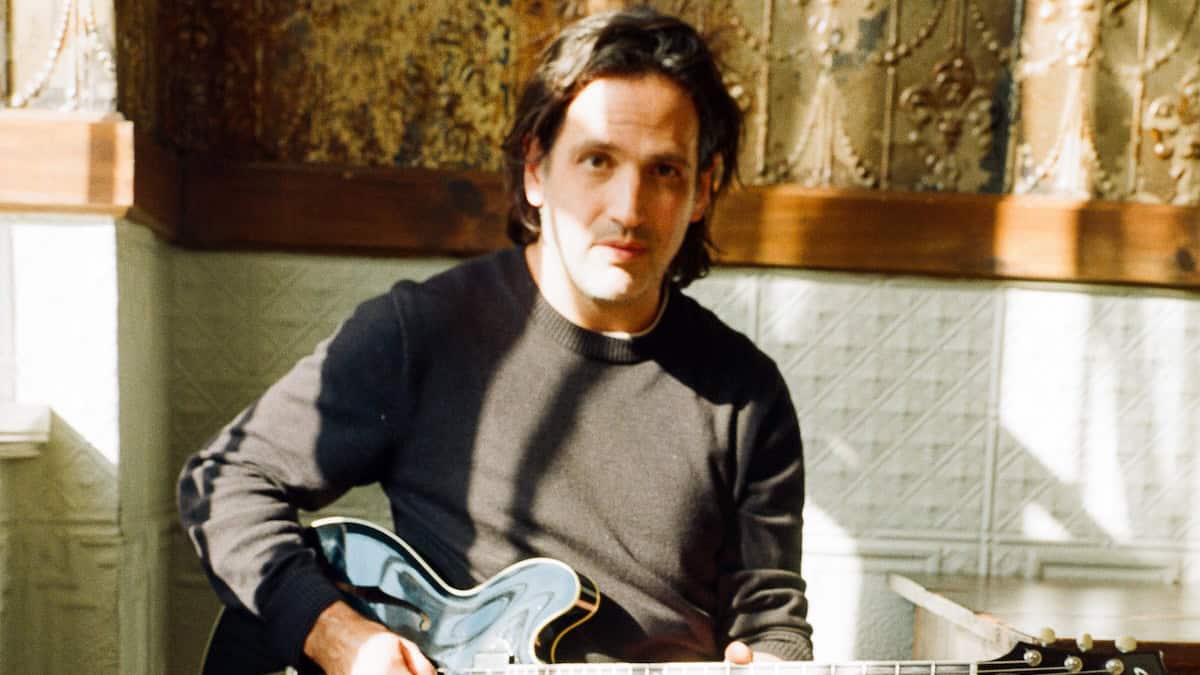
JGT contributor Joe Barth talks to Jonathan Goldberger about jazz guitar, film composition, and his new album with the Selcouth Quartet.
Jonathan Goldberger grew up on the outskirts of the Everglades in Florida. After a time of studying with pianist Art Lande in Boulder, Colorado, he moved to New York City to study with pianist Paul Caputo.
JB: You haven’t been featured in JAZZ GUITAR TODAY. So, tell me about yourself before I ask about the new album. Growing up in South Florida, when did you start to play jazz guitar, and what was most helpful in your personal development as a guitarist?
JG: I became interested in classical guitar when I was around 14, although I was a drummer before that. The teacher I was studying with at the time happened also to be a really great jazz upright bass player, as well as a guitarist. He tried to push me into more of a jazz education and at the time, I think I sort of resisted. It seemed like too much work! But as I discovered the 70’s era Miles Davis, as well as Bill Frisell, it became clear that “jazz guitar’ could take a lot of different forms. As a teen, I was also listening to a lot of psych and prog-rock guitarists like Hendrix, Steve Howe, David Gilmour, and Frank Zappa, and could see the connection to guitarists like Mclaughlin, Abercrombie, and Frisell. I don’t think it was until I was at the University of Colorado and playing in jazz combos that I really immersed myself into the full history of jazz guitar: Jim Hall, Wes Montgomery, Charlie Christian, and beyond. I got to study with Dale Bruning, one of Frisell’s early teachers, while I was there.
JB: Talk about the impact that pianist Art Lande had upon your playing.
JG: Huge! Art is truly one of the greatest, both as a player and a teacher. He taught me to think of free playing more as composition, with a need for structure, contrast, and emotion. Free improvisation didn’t always have to be atonal and non-rhythmic. In the same way, playing jazz standards could be free of form and opened up in unconventional ways. Music is music, don’t get stuck in a clique and box yourself into the boundaries of those labels “I’m a free-jazzer”, “I’m a straight-ahead player”, “I’m a rocker”…ditch all that and just make the music that you’re hearing and inspired by. Art had a weekly series at a dive bar called The Westend. It was like going to church every week. I vividly remember my mind being blown while hearing him play duo with trumpeter Ron Miles, who was the other titan of my 90’s/college-era music education and development. Same thing: Ron was pulling from across the spectrum, from Nirvana to Miles to Bach.
JB: What are three of the most influential jazz guitar albums to you and why?
JG: Tough to say, this would likely change from day to day, here are a spontaneous three…
Where in the World – Bill Frisell. I bought this at the mall after reading a Guitar Player magazine blurb…I think I was 15. I’d never heard anything like it…even to this day. It’s like a broadcast from the future. Needless to say, Bill has such a unique sound and voice – everything sounds so perfectly in place, so elegantly constructed…nothing superfluous. There’s jazz, country, metal, ambient, and rock – but it so naturally fits together completely unforced, minimalist virtuosity.
Ask the Ages – Sonny Sharrock. Another 90’s gem! Bill Laswell produced with Elvin and Pharoah! Simple swingin’ tunes with blistering intent and emotion. They’re all just on fire as a band – Sharrock’s tone is scalding and raw.
Undercurrent – Bill Evans/Jim Hall. Classic 60’s era Jim Hall. What is there to say other than Jim paved the way: beautiful, understated, economic playing, tone for days, harmonically ahead of its time.
JB: You have a special musical chemistry with saxophonist Stuart Bogie, bassist Jon Shaw, and drummer Joe Russo. Reflect upon your working relationship with them.
JG: Joe and I go back almost 30 years. We met in Boulder, and he studied with Art, too. We’ve been playing on and off in various projects and did our first tour together. It’s very easy to play with him, a lot of trust and support. With Bogie and Shaw, they’ve been friends for a long time, our musical relationship doesn’t go back as far, but they’re similarly inspiring to work with. Bogie and I have to share a lot of melodic and linear spaces in the quartet. He’s got such a great sense of orchestration and texture with the million instruments he plays. The band just keeps evolving every time we play.
JB: The new album Selcouth Quartet was recorded in just five days at the Floki studio in Iceland and features nine compositions. Reflect upon the material selection and preparations for the recording.
JG: It was an unusual birth of a band in that we hadn’t really played together much as a quartet. We were invited to Iceland to make a record without any material or rehearsing. Our initial plan was to just improvise and hopefully pull a record out of it. We arrived at the studio in peak winter, on the northern coast, everything covered in ice and snow. It was really remote, at the edge of the Arctic Circle. We were so inspired by the landscape and beauty, that I think we had a collective creative shift and decided to compose together as a band, rather than strictly improvise. The new plan: create one track per day—and that’s what happened. It was such a luxury to have that amount of time in a great studio and also with a fantastic producer/engineer (D James Goodwin).
JB: All four of you are highly skilled improvisers, so with the songs how much melodic and harmonic material is written down and placed in front of the musicians, and how much is created in the moment?
JG: It was almost all created in the moment – we had zero written material when we arrived. I had a notebook and would scribble things down as we wrote and rehearsed just for reference on the more intricate parts.
JB: For the musical textures you wanted to create, tell us about the guitar and amp you used for this project.
JG: Due to the remote location, I was reluctant to bring my 63’ Jazzmaster (which I’ve since been playing live with the band), so I brought my number 2, which is a faux-tele that I built from parts over the pandemic. It has a Gibson scale neck that I love, a P-90 in the neck. and a Tele bridge pickup. I learned a lot about the mechanics of guitars by putting that thing together. I went through several necks and pickups until it felt right.
Once I’d finally settled, I had Matt at 30th Street Guitars go over my crappy tech work and make it great – now I LOVE that guitar. They had a really nice old Regal parlor acoustic at the studio – that’s the acoustic you hear on the album. I also have a lovely Collings I30 that gets played a lot. Also, D’Addario strings, cables, picks, etc.
In terms of electronics – just my pedalboard…it changes, although most likely a Chase Bliss Mood and Tonal Recall, Count to 5, Sun Face fuzz, and various others. I used the amps they had in the studio: a Supro and a Princeton reissue. At home, I have a bunch of 60’s/70’s Fenders, Ampegs, and Gibsons.
JB: In a more general sense, you have worked with many wonderful musicians, but I want to ask about the impact that John Zorn has had upon you.
JG: I bought Zorn’s album Naked City when I was a teen, tracking down all the Frisell albums that I could find at the time. I’d never heard anything like it. Again, it was mind-blowing by the sheer inventiveness and punk energy. I later saw his band Masada play when I was in college in the 90s – it was one of those pivotal moments in live music that confirmed that this was what I wanted to do with my life (it was a fantastic concert!). Fast forward ten-plus years and I’m playing with another hero of mine, drummer Jim Black. Zorn had asked Jim to put together a group to perform his music from a new collection of compositions that he had written called “The Bagatelles.” Jim asked me (along with Simon Jermyn and Keisuke Matsuno) and we started playing this music at The Stone in New York City, along with rehearsals with Zorn. It was super inspiring and a dream to be working with both Jim and John. We later played at the Village Vanguard, and finally made a record for Zorn’s label Tzadik that came out last year (Bagatelles vol. 11 – Jim Black Quartet).
JB: As a film composer, reflect upon your experiences providing music for the films Trans and The Hawk is Dying.
JG: They were quite different experiences – although both films were directed by my brother, Julian Goldberger. His first film, Trans, it was less about scoring to picture, and more about trying to get a general feeling and atmosphere that connected with the image and story. This was 1999, DAWS and digital editing were still in their infancy, and Trans was made with a low budget, in a true renegade DIY spirit. The Hawk is Dying, his second film was made around 2006, and so it was more of a formal score for me – writing to picture, spotting cues, etc. There isn’t any guitar in the score – just string quartet, vibraphone, bass clarinet, piano. It was an exciting and intense project to get to do. At the time, I was studying with Paul Caputo, the legendary counterpoint and harmony teacher in New York City, which greatly helped my writing for non-Guitar-based music. Working with my brother was a breeze, as we grew up in a shared musical world, he’s incredibly deep in his musical taste (and as a musician). I remember him sending me composer Morton Feldman tracks to check out for inspiration and thinking it doesn’t get any cooler than that. I was spoiled working with him. I later learned that most directors don’t have that level of musicality, nor trust in a composer. I’m really proud of both films, they both went to Sundance, and Hawk also went to Cannes.
Subscribe to Jazz Guitar Today – it’s FREE!
Thank you for reading this post, don't forget to subscribe!


New Album From Tom Lippincott, Ode To The Possible

Colombian Jazz Guitarist Daniel Pinilla

Jazz Guitar Today Pays Tribute To Guitarist Joe Negri

Video Podcast With Giuseppe Continenza
Italian Guitar Master, Giuseppe Continenza

Nexus From Guitarist Jordi Farres

New Vince Lewis Guitar Arrangement, “What The World Needs Now”

Veda & The String Machine’s New Album, Rise And Shine

Jazz Guitar Today Lesson: Variations On Standard Jazz Blues Chord Changes – Part 2
Jazz Guitar Today Lesson: Variations On Standard Jazz Blues Chord Changes – Part 1
Jazz Guitar Today Lesson: “Pensative”
New Vince Lewis Guitar Arrangement, “What The World Needs Now”
New Vince Lewis Guitar Arrangement, “Anything Goes”

Saying Goodbye To An Atlanta Jazz Musician, Sal Gentile

Guitar Great Ron Eschete’ Dies at age 77

British Smooth-Jazz Guitar Master, Chris Standring
-

 Jazz Guitar Lessons2 weeks ago
Jazz Guitar Today Lesson: Variations On Standard Jazz Blues Chord Changes – Part 2
-
Jazz Guitar Lessons4 weeks ago
Jazz Guitar Today Lesson: Variations On Standard Jazz Blues Chord Changes – Part 1
-
 Jazz Guitar Lessons2 weeks ago
New Vince Lewis Guitar Arrangement, “What The World Needs Now”
-
Artist News3 weeks ago
Guitar Great Ron Eschete’ Dies at age 77

