
Artist News
Ben Monder Performs on Jerome Sabbagh’s New Album, Stand Up!

JGT contributor Joe Barth sits down with guitarist Ben Monder.
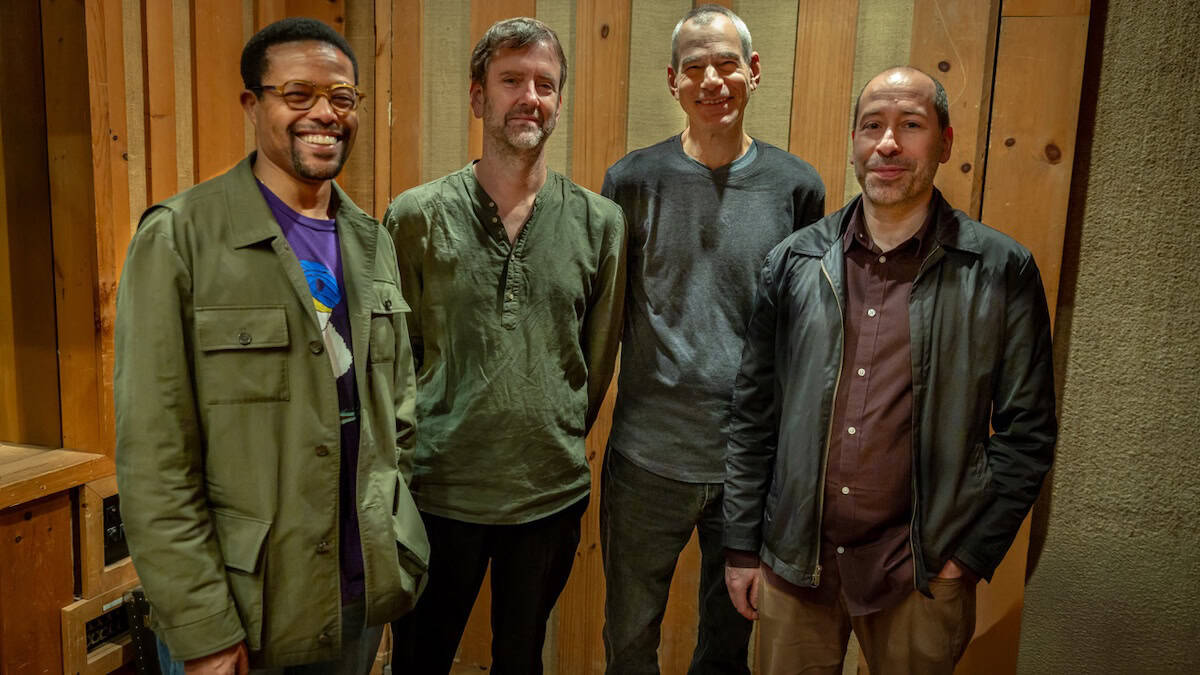
Photo above: Jerome Sabbagh Quartet © Adrien H. Tillmann
Born in New York City in 1962, Ben Monder began playing the guitar at the age of eleven. Studying at Queens College and the University of Miami, and like many guitarists, worked with Brother Jack McDuff’s organ band. He has several albums out under his own name as well as a sideman, working with the “who’s who” of jazz. In August of 2021, he replaced pianist Orrin Evans in the Bad Plus. As a sideman, he played with saxophonist Jerome Sabbagh on Jerome’s new album Stand Up. I have a conversation with both Ben and Jerome about the making of this new album.

JB: Ben, you haven’t been featured in JAZZ GUITAR TODAY. So, before I ask about the new Stand Up! album, tell me about yourself. You grew up in New York, and you’ve studied at Queens College and Miami University. During your college years, what was musically most helpful in your personal development as a guitarist?
BM: What has helped me the most as a musician in general is playing with other people. The better they are, the more I improve, and the times I’ve had regular gigs or been the busiest playing professionally are the times I’ve developed the most. But since you ask specifically about college years, I wasn’t playing out all that much at that time. What helped my musicianship the most was intensive listening and studying a wide variety of music. I was also practicing as much as possible, of course. Come to think of it, I was doing gigs the last couple of years of college, but they were mostly with an R&B band…
JB: Ben, to learn more about what shaped your musical values on the guitar, what are three of the most influential guitar albums and why?
BM: Jim Hall Live!
This is not the first Jim Hall album I heard, but it’s probably my favorite. When I first heard him, it was a revelation; I had never heard a guitarist improvise so compositionally and economically before, all the while taking bold chances both harmonically and rhythmically. This album exemplifies that quality more than any other. He also had one of the loveliest jazz guitar sounds ever.
Paul Motian – It Should Have Happened a Long Time Ago
Not Bill Frisell’s album obviously, but as good a showcase for his brilliance as exists. His personal sense of harmony and his sonic vision seem to have no precedent, yet feel like they always had to have existed. He pushes emotional and aesthetic buttons that I only knew I had after hearing him.
John Scofield – Bar Talk
Another wholly personal conception that seems to have come out of nowhere. In addition to the guitar playing, he is also one of my favorite composers in the jazz idiom. I love how stripped down and unproduced this album is, allowing the strength of the songs and the playing to shine, and how his ideas tumble out in the most organic way. I acquired it shortly after seeing this trio for the first time in probably 1981, and since they played in the area quite a bit, I would follow them around. I could name a number of Scofield albums I love, but this was an early and important inspiration for me.

JB: Jerome and Ben, tell us what you enjoyed most in making the new Analog Tone Factory quartet album Stand Up! with bassist Joe Martin, and drummer Nasheet Waits?
Jerome: This quartet is more or less “home base” for my music. With the exception of Nasheet, it’s the same band that I recorded my first album as a leader with, North, in 2004, so there’s a lot of history there: three records – now four-, many tours, 20 years of music making. Most of the music I’ve written over the last 20 years has been written with this particular unit in mind. It just feels really good to play with this band, it always has, and it still does. In the context of recording and trying to play in a way that feels fresh despite being in the studio, which is not easy to do, having people you know really well and can trust is key. In general, I enjoy any moment that’s unscripted and feels organic. Fortunately, I feel we were able to capture some of those on this record. Nasheet also brought a different point of view from the drums, and hearing him bring these tunes to life was a highlight for me.
BM: My relationships with all the musicians on this album go back many years. They are all among the best players on their instruments, as well as some of my absolute favorites. It was great that we were able to record this album all in the same room with no headphones, which almost always makes for a more dynamic performance. What I find inspiring about Jerome’s tunes is the balance he strikes between lyricism and complexity. They are harmonically interesting enough to be challenging and simple enough to dig into.
JB: I can’t ask about all the songs that Jerome composed for this album. But let me ask about a couple. Tell me about “The Break Song” and its relationship to Stevie Wonder?
Jerome: I am a big Stevie Wonder fan, particularly the seminal albums from the seventies. Even though his sad songs are incredibly deep, to me, he is also one of the great songwriters of “happy songs”. There’s a certain boundless energy and joy in his singing and the way he writes harmonies. The way “The Break Song” turned out – some of the harmony, and the beat – made me think of that, so I dedicated it to him.
JB: Trent Reznor’s dad, Michael, used to play violin in my Hot Club band in Pennsylvania. So, I’m curious about the song “Mosh Pit” and its relation to Trent.
Jerome: It’ a bit of an oblique reference. I never got to see Nine Inch Nails live, but at a certain point in my life, I listened to The Downward Spiral and The Fragile a lot. I found the energy, the creativity, and the unique mix of rawness and sophistication on these records really appealing. I remember a friend going to a show telling me how great their live show was, and how insane the mosh pit was. Even though the tune I wrote has a different kind of high energy going on, it seemed appropriate to make a reference! Sometimes inspiration isn’t linear …
JB: Jerome and Ben, you both worked with the great drummer Paul Motian, so tell me about “Vanguard.”
Jerome: In September 2011, Ben and I played as a trio with Paul Motian at the Village Vanguard for a week. It was Paul’s gig, and he called it his “New Trio”. It remains one of the highlights of my musical life. Paul was already sick – he would pass on November 22 that year – but I couldn’t really tell from his playing. Everything he played that week was just on such a high plane of musicality, of intention. It was actually much easier to play with him than I expected, having listened to him all these years. Ben, of course, had played with Paul a lot, but I hadn’t. Paul sounded amazing, and he also made me sound better. He was such a great musician and listener. It was all leading by example, as he didn’t say much, at least not in this instance. He elevated the gig, all 12 sets of it. There was no lull of intensity in his playing the whole week. It was so great to play with him, and particularly to play trio with Ben, with whom I already had a lot of history. The trio format gave us a lot of space to interact and come up with things. I wrote “Vanguard” thinking of that week, and of Paul’s writing, which I love.
BM: Paul was a visionary, and it may be a cliché, but he was the rare musician who transcended his instrument. He had such a powerful conception that all of his many groups, which included a huge variety of musicians from across the spectrum, always sounded like a Paul Motian band. I had the honor of playing with him in a few iterations of his bebop band, the Bill McHenry quartet, and the trio with Jerome. The vast majority of these gigs were at the Vanguard itself, and the song is an effective evocation of his sound world.
JB: Ben and Jerome, what did you appreciate about your musical relationship as saxophonist and guitarist on this project?
BM: I’ve always loved playing in Jerome’s quartet and have been doing so for over 20 years. It always feels like he’s improvising, and there is a rootedness to the tradition that I value. A really mature, patient, and swinging player. And there is a nice variety to his tunes that makes me access different approaches to the instrument. Always a fun time!
Jerome: I love Ben’s playing, the variety of it in terms of sound, also both the openness and the specificity of it. There are definitely quite a few tunes in my book that I wrote specifically with him in mind. He’s a great accompanist. He listens and strikes a great balance between supporting what the band or the soloist does and also taking it elsewhere if warranted. It’s a rare quality. I like the sound of saxophone and guitar together, and it’s been a defining thing in my musical life as a listener, whether Sonny Rollins with Jim Hall, Scofield with Joe Lovano, or Kurt Rosenwinkel with Mark Turner. I feel drawn to good guitar players in general, and I am fortunate that Ben and I have been able to develop a thing together for 20 years now. He’s really able to inhabit my tunes and make them shine. He gets inside the music and makes it his own, while still staying true to the essence of the tunes. That’s not that easy to do. And of course, he’s a fantastic soloist, with a unique voice, which is what we all aspire to!
JB: Ben, you have several guitars. What do you appreciate most about the 335-style guitar you currently play the most?
BM: I’ve had that guitar (an Ibanez AS-50) since 1983, and it feels part of me at this point. I’ve grown into its sound, and it manifests what I envision for the guitar better than any other I’ve ever tried. It’s also extremely easy to play. I use 13’s, but for some reason, they feel much lighter on this guitar.
JB: Ben, what do you musically appreciate most about the challenge of taking the piano’s place in the Bad Plus?
BM: I don’t think in terms of taking the piano’s place – I see it as just a completely different band. In fact, I try not to think about how the piano navigated some of the older tunes in order to better interpret them for myself, as a guitar can’t emulate a piano very effectively. That said, I am a big fan of both trios! Anyway, I just try to fit into Reid and Dave’s concept as organically as I can while still being myself. And saxophonist Chris Speed is really strong and personal player, so it’s all about merging intuitively.
Thank you for reading this post, don't forget to subscribe!


Nexus From Guitarist Jordi Farres

New Vince Lewis Guitar Arrangement, “What The World Needs Now”

Veda & The String Machine’s New Album, Rise And Shine

New Recording From Guitarist Doug MacDonald, Tribute To South Central

Joe Negri Dies Just 10 Days before His 100th Birthday

Jazz Guitar Today Lesson: Variations On Standard Jazz Blues Chord Changes – Part 2

Guitar Great Ron Eschete’ Dies at age 77

One of Chile’s Finest Fingerstyle Guitarists, German Herlein
Jazz Guitar Today Lesson: Variations On Standard Jazz Blues Chord Changes – Part 2
Jazz Guitar Today Lesson: Variations On Standard Jazz Blues Chord Changes – Part 1
Jazz Guitar Today Lesson: “Pensative”
Jazz Guitar Today Lesson: “Central Park West”
New Vince Lewis Guitar Arrangement, “What The World Needs Now”
New Vince Lewis Guitar Arrangement, “Anything Goes”

Saying Goodbye To An Atlanta Jazz Musician, Sal Gentile

Jazz Guitarist Eleonora Strino Talks To JGT
-

 Jazz Guitar Lessons9 hours ago
Jazz Guitar Today Lesson: Variations On Standard Jazz Blues Chord Changes – Part 2
-
Jazz Guitar Lessons2 weeks ago
Jazz Guitar Today Lesson: Variations On Standard Jazz Blues Chord Changes – Part 1
-
Jazz Guitar Lessons7 hours ago
New Vince Lewis Guitar Arrangement, “What The World Needs Now”
-
Artist News2 weeks ago
Guitar Great Ron Eschete’ Dies at age 77


