Artist Features
The Many Expressions Of Jazz With Marko Čepak Maki

JGT’s Joe Barth talks to Slovenian jazz guitarist Marko Čepak Maki.
Slovenia is known for its beautiful mountains and lakes, but there is also a lot of beautiful music there. Jazz is alive and well in its capital, Ljubljana, and elsewhere around the country, and if you are listening to jazz on the guitar, you may very well be listening to Marko Čepak Maki. Marko keeps himself busy performing many expressions of jazz, from modern to ragtime, big band, and more.
JB: Growing up in Slovenia what inspired you to play jazz guitar?
MM: I’ve been inspired by many different people and music experiences I gained through the years. Although the jazz scene in Slovenia, especially in the part where I grew up, was not so widespread, jazz music somehow found its way to me.
My parents enrolled me in a music school where I learned classical guitar. My teacher soon noticed my enthusiasm and persuaded my mother to pay for extra private electric guitar lessons where I learned modes and the basics of improvisation. My interests started moving from rock to jazz. In my early twenties, I started my own Latin jazz fusion band. It was during that period that a jazz saxophonist from England immigrated near my home, joined the band, and introduced me to traditional jazz.
JB: What did you appreciate most about what you learned about guitar playing at the Tartini Conservatory of Music in Italy?
MM: I am really grateful to my teacher Riccardo Chiarion, because he pushed me to know jazz vocabulary through its history. He had also prepared excellent didactic exercises to gain full control of harmony on the fingerboard and to gain the speed of mind that jazz music and improvisation require.

JB: To you, in your personal development, what are three of the most influential jazz guitar albums and why?
MM: First would be by Brazilian guitarist Nelson Veras, album Solo Session Vol. 1. This inspired me a lot because of its beauty regardless of the complexity of the playing. Nelson’s technical skills, sense of rhythm, timing, and polyrhythms are his specialty. He continually surprises the listener with fresh ideas of great artistic value because they always serve the music itself. His phrasing is so fluid and flows from idea to idea with extraordinary musicality. I am sure that this album sounds very enchanting, even for a non-musician ear, something that is very hard to achieve, especially when playing solo.
Next would be the band Scenes and their album Destinations, which features John Stowell on the guitar. Unconventional phrasing and chord voicings that do not resemble a typical jazz guitar approach. This is what we used to listen to at school with my colleagues during that period of my life. John’s ability to search for melodies within his very original harmonic substitutions leads to a non-traditional pattern of playing that has always been an inspiration to me. At the same time, the sound and atmosphere reminded me of a traditional jazz guitar but with lots of originality. These characteristics got anchored in my head forever.
The third would be Secret Story by Pat Metheny. This album, with its wonderful compositions, had a great influence on me. It represents a kind of combination of different world music styles with beautiful orchestral arrangements that include choirs and African odd meters and subdivisions, which appeal to me because of my Balkan culture. Within this very ambitiously written work, Pat also left space for improvisation, where he plays some of the most melodic and singable guitar solos. It is pure beauty!
JB: Is Ghost in the Corner, which you recorded with guitarist John Stowell, your newest CD? Tell us about it and what it was like working with John.
MM: No, this CD was recorded back in 2019, and I’ve done a few others since. But John is such a gentleman and a good friend. It was really fun for me to record this CD even though we did it all in one day. Through our years of collaboration, he and I have developed a special syntony when playing together. I am honored to work with him because the work is always done at the highest level but in a very relaxed manner. We play regularly once or twice a year, usually for a week. For this record, the songs we chose were not written exclusively for this CD but were rearranged for this quartet; this was how we played the repertoire live. The songs were all original, composed by John, me, and our Slovenian drummer Aljoša Jerič.

JB: Tell us about your CDs Life Compass On! with the Artbeaters and Swinging Heaven with Swingtan.
Live Compass On is special to me because I was back to playing fusion guitar with some distortion moments, which I haven’t played since I started studying at the conservatory. Each of us brought our own songs, which were written down to the last detail exclusively for this band.
Concerning the other album, we started Swingatan to create a band where we would only play acoustic instruments with no amplification because none of us had had such a band before. It is refreshing to play this way occasionally.
JB: What do you appreciate most about the Luka Zaletelj guitar you use?
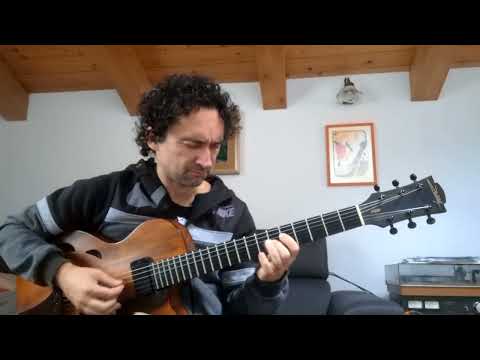
MM: As for the craftsmanship itself, his guitars are uncompromisingly well made, down to the smallest detail, using the highest quality woods and materials. The sound is very balanced, and playability is amazing. The strongest point I guess, is in the acoustic and percussive qualities, which are reflected in great dynamics, and this inspires me a lot. The guitar seems to follow you so you can express yourself in every moment.
JB: Talk about the jazz scene where you live and how you are able to make a living playing music there.
MM: I feel privileged where I live, because I am surrounded by musicians and friends from Slovenia, Croatia and Italy. I speak all three languages, and to me, it feels like one big home. The jazz scene is quite strong in the three countries, and we are all connected, musicians and organizers. Even though it is a small country, Slovenia has some important jazz festivals. I go to Italy almost every day because I teach jazz guitar there, and right across the border, there are some big festivals where every year jazz superstars from all over the world are invited. There are a lot of possibilities for playing and creating music here.
JB: What advice would you give young American musicians who want to play gigs in Europe?
MM: The same advice I would give to myself. Play with your own sound from your heart, telling your own story. Try in the best possible way to reach the hearts of the listeners who know nothing about music.
Thank you for reading this post, don't forget to subscribe!