
Artist Features
New York Guitarist John Merrill

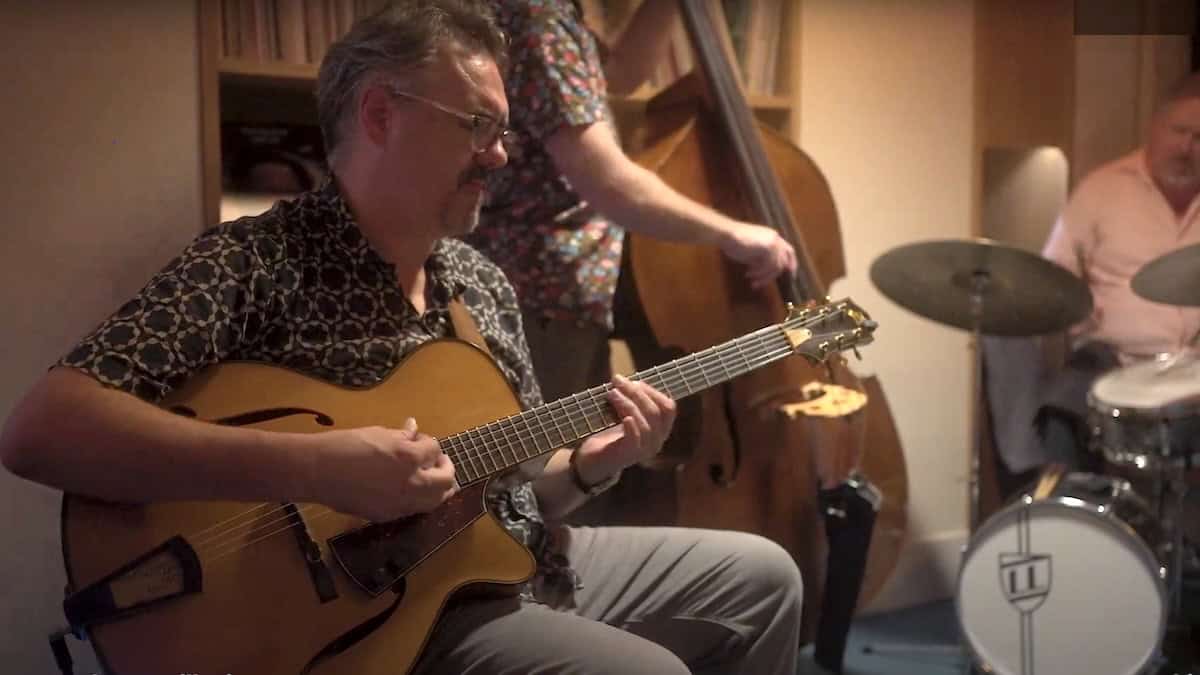
JGT contributor Joe Barth reaches out to guitarist John Merrill to discuss latest projects and performing around NYC.
Connecticut-born guitarist John Merrill keeps himself busy performing around the New York metro area. In addition to his regular gigs, he is a member of Professor Cunningham and His Old School, which is one of the finest Swing and Dixieland bands in the New York area.
JB: Talk about what inspired you to play jazz guitar.
JM: I began taking guitar lessons in Portland, CT, at age 13 with David Stoltz, a Hartford-based electric bassist and guitarist. We studied from the classic Mel Bay Volume 1 to cover the basics. Very soon into our lessons, he introduced me to many of the great guitarists, including George Benson, Wes Montgomery, Pat Martino, and Jim Hall, and recommended recordings to listen to. In addition to this, my next-door neighbor, Leonard Brown, was a saxophonist and jazz scholar. He was very encouraging, and he also introduced me to many classic jazz recordings. He took me to my first jazz concert at Wesleyan University, which was a revelation to me when I was 14. It was a quartet with saxophonist Bill Barron (Kenny’s older brother), Kenny Barron, Ray Drummond, and Ben Riley. I was awestruck, and from that moment, I had an insatiable appetite for jazz music.
JB: Did you study music in college and talk about the musical things you appreciated most about those years of your life?
JM: Yes, I completed a BFA in Jazz Performance from the New School in New York City in 1997. It was an opportunity to be completely immersed in the jazz scene of New York City. The faculty was magnificent and included people like Arnie Lawrence, Junior Mance, Vic Juris, and Jim Hall. I studied a great variety of things there, including transcription, arranging, composing, ensemble playing, and, of course, intensive guitar studies with my primary teacher, Mark Elf.
During these years I was fortunate to have a gig playing about 3 to 4 nights a week at Panchito’s – a Mexican restaurant on MacDougal Street in Greenwich Village, which was also downstairs from the fifth-floor apartment I lived in at the time. I played duo with a bassist at first and later they got a piano and we played trio. I learned so much during those years, especially by playing with more advanced musicians who challenged me and helped me develop.
JB: To you, what are three of the most influential jazz guitar albums in your own personal development and why?
JM: The three albums that stand out are Wes Montgomery Trio A Dynamic New Sound, Kenny Burrell Blue Lights Volume 1, and Sonny Rollins The Bridge.
Wes’s album had such a warm sound and the groove felt incredible – he was the great communicator of the guitar. His “Yesterdays,” “Round Midnight” and “The Breeze And I” blew me away. I listened to that record countless times.
Kenny Burrell I came to just a little later, but I was really attracted to his tone and feeling. His chord melody playing on “Autumn In New York” was approachable, and I remember learning “Rocksalt” and “Chuckin’” from the record, which was a lot of fun for me. I was able to mimic his melodies and lines from his solos and I really took a lot of ideas from him.
And then there was Jim Hall’s playing on The Bridge. It was so captivating to me. He had a rich palate of harmony and was such an interactive player. He also had unique and beautiful solos.
Of course, I also enjoyed many other albums like those from George Benson, Pat Martino, John Abercrombie, Charlie Christian, Tal Farlow and Barney Kessel. But I think that the three that I picked are exemplary for the depth of feeling and rich guitar tone, which is what attracts me above all else.
JB: Talk briefly about working with Professor Cunningham and His Old School.
JM: I began playing with Professor Cunningham and His Old School in 2013. We recorded several albums over the next ten years, and we toured in about 20 countries, playing for swing dance events and in clubs and concert venues. I have enjoyed it immensely and it has helped me to further develop my big band-style rhythm guitar skills. It’s an opportunity to play New Orleans style party jazz, some traditional repertoire and classic Basie and Ellington. Adrian is an incredible band leader and performer. There are several hundred arrangements in the book. At the same time, he knows how to keep the music spontaneous and fresh and to excite audiences. I’m always on my toes when I’m working in that band.
JB: Tell us about your latest CD, Dancing in the Dark.
JM: This last album is fairly off the cuff in that I didn’t worry about over-arranging the material. Instead, I relied on the years of experience that I’ve had playing with bassist Neal Miner and drummer Brian Floody. We’ve played so many gigs together, and it was a comfortable session playing some favorite American Songbook and Jazz standards. I am happy with that recording, and we had a really good time doing it.
JB: I’m sure you do a lot of accompaniment work, like with Julie Zhu, tell me what you need to be mindful of as an accompanist to a singer or a saxophone.
JM: There are several factors that enter into being a good accompanist. The first is knowing the material that you are playing as well as you can. That comes from listening to multiple renditions of a song and making sure when you are using sheet music that it comes from reliable sources. Internalizing lots of the great songs is so important. That means playing them in chord melody style and also just playing the chords and singing the melody. I also really like to play the melody along with a recording of a singer and pick up phrasing ideas from that.
All of that kind of work helps in reaching the goal of any good accompanist, which is to be a very good listener and do everything possible to make a vocalist (or instrumentalist) feel comfortable in expressing the song. Some singers might need to hear some of the melody notes in the top of the chord for example, whereas others might really not like that at all. I try my best to stay attuned to those sorts of details. In addition, one needs to develop the skill to play clear intros and endings. And finally, I would add that being as precise as possible with comping, both rhythmically and harmonically, is vital to making it all work.
JB: Tell us about the primary guitar you play.
JM: I have a 1999 Jazz Deluxe Archtop made by the late John Zeidler. It is fitted with a modified (floating) full-size Gibson Humbucker pickup. It’s a wonderful guitar – very responsive, and it feels great to play.
JB: New York is a town with hundreds of good guitarists, you’ve been there for over twenty years, so what’s the best piece of advice you’d give younger guitarists for building a career in music?
JM: Yes, 31 years now, to be exact! I think the best piece of advice is to really enjoy the journey of learning to play. Find some players that you love and go listen to them. Watch how they do it. The guitar is an incredibly versatile instrument with myriad approaches. Music comes first – don’t get carried away with flashiness – and learn how to perform as a solo guitarist. Create some nice arrangements on tunes and then build upon them. I remember playing an arrangement I had on “Shiny Stockings” for Jim Hall. He said, “That sounds good – now do something different with it!” That’s the beauty of what we do – there’s always room for a new twist or a different approach to things!
Subscribe to Jazz Guitar Today – it’s FREE!
Thank you for reading this post, don't forget to subscribe!


Guitar Great Ron Eschete’ Dies at age 77

One of Chile’s Finest Fingerstyle Guitarists, German Herlein

Jazz Guitar Today Lesson: Variations On Standard Jazz Blues Chord Changes – Part 1

Jazz Guitar in War-Torn Tel Aviv

Guitarist Tomas Janzon Releases New Album, Jazz Diary

Jazz Guitar Is Alive And Well In The Czech Republic

Guitarist Greg Ruggiero Talks To Jazz Guitar Today

Guitarist Russ Spiegel Releases New Album: TimePieces
Jazz Guitar Today Lesson: Variations On Standard Jazz Blues Chord Changes – Part 1
Jazz Guitar Today Lesson: “Pensative”
Jazz Guitar Today Lesson: “Central Park West”

New Vince Lewis Guitar Arrangement, “Anything Goes”

Jazz Guitarist Eleonora Strino Talks To JGT

Saying Goodbye To An Atlanta Jazz Musician, Sal Gentile

British Smooth-Jazz Guitar Master, Chris Standring
Guitar Great Ron Eschete’ Dies at age 77
-
 Jazz Guitar Lessons2 weeks ago
Jazz Guitar Today Lesson: Variations On Standard Jazz Blues Chord Changes – Part 1
-
 Artist News1 week ago
Guitar Great Ron Eschete’ Dies at age 77
-
 Artist Features3 weeks ago
Guitarist Greg Ruggiero Talks To Jazz Guitar Today
-
 Artist Features3 weeks ago
Jazz Guitar Is Alive And Well In The Czech Republic